


Let's say you're having a website redesigned. What are the main things you're focused on?
For most companies, the process looks something like this:
- Look through design portfolios to narrow the selection.
- Contact those firms to get pricing information.
- Narrow the choices to a few contenders and speak with each of them.
- Hire one.
- Communicate information about the brand, color palette, and general style to the design team.
- Send the design team example websites you like.
- Skip professional copywriting and write your own.
- Skip custom photography & graphics. Use stock photos.
- Skip site architecture & UI planning.
This process puts the entire focus of the website design on the container instead of the stuff that goes inside that container.
I'll get into what I mean by the "container," but it's But the container doesn't matter. The container is irrelevant, it's just a container. The only thing that matters is the content inside that container.
Content is more important
Copy is content.
What does it say? Is it convincing? Does it clearly communicate the product's benefits?
Photography & graphics are content.
What do they communicate? Do they support the copy? Are they even necessary in the first place?
Page and site architecture is content.
Is everything organized in the most effective way possible to communicate the message? Is anything hard to find? Is anything redundant or unnecessary?
A website is a tool
A website is a functional tool. It exists to serve a purpose.
Imagine designing a hammer and completely ignoring its core function.
Imagine putting the entire budget of hammer design toward slapping pretty flowers on the handle and finding the perfect shade of midnight blue to paint the claw.
Then you just build the thing out of cheap plastic and ignore its core purpose: hammering nails.
That is what companies do when they focus the entire effort on the design of the container and half-ass the stuff that goes inside the container.
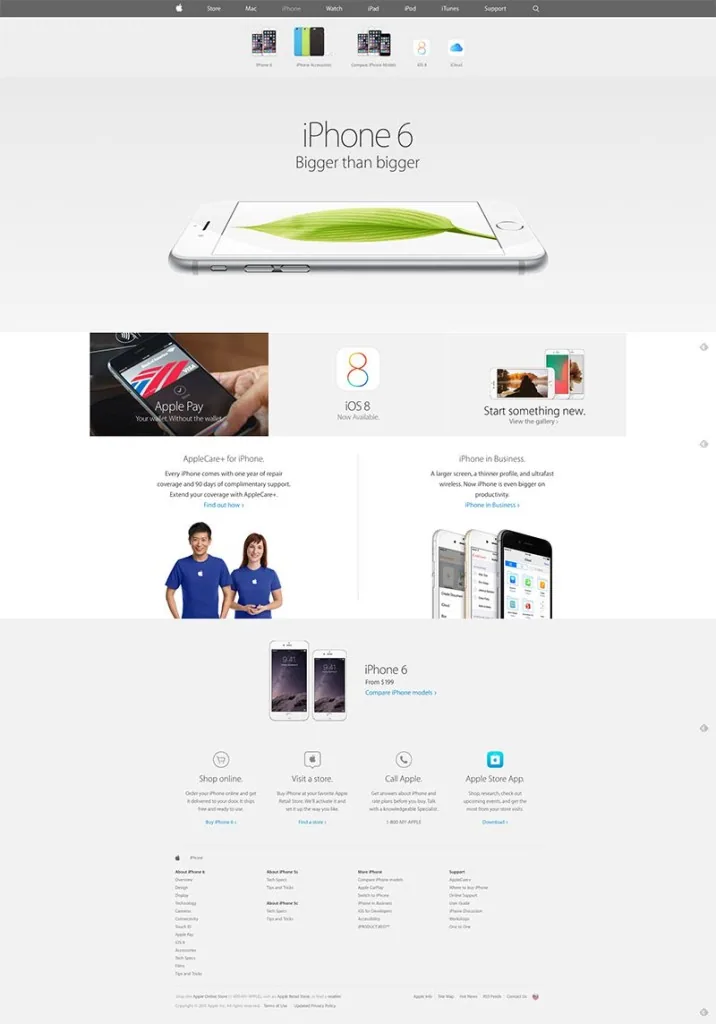
Here's what Apple's container looks like:

Here's that same container with content
How to solve the problem
This is an easy problem to solve. Reverse your priorities. They should be in this order:
1. Copy
What do we want to say?
What is a real value proposition that will resonate with our customers?
2. Page & site architecture
Now we know what we want to say, but where do we want to say it?
How should the information on each page be organized?
How should the site as a whole be organized.
3. Icons / graphics that directly support the copy
Phone icons next to phone numbers, your logo at the top of the page, shopping cart icons to add something to the shopping cart.
Everyone goes overboard on this…don't do that.
4. Custom photography
Avoid stock photography at all costs.
Stock photography says two things about a company:
- We couldn't think of anything to put here and thought a generic image of two business people shaking hands would accomplish something.
- We're too cheap to properly showcase our product, service, or team members.
You don't want your customers getting either impression.
5. Container design
Worry about this last, and only if you have the budget after everything else is awesome.
And know that this is overdone to the extreme.
Nobody cares if your video has a fancy border around it. Nobody cares if your nav menu is plain or has a blue gradient background.
Your customers do care what makes you different. Your customers do care what your product looks like. Your customers do care to see examples of your work.
Next time, try this
Look through portfolios to find companies that build websites with convincing copy, well-though out site architecture, and functional imagery. Ignore the container and evaluate the stuff your customers care about: the stuff inside that container, the stuff that sells.