


You may have heard that search engines like "fresh content."
In other words, that you'll drive more traffic if you publish more content more frequently.
If you Google, "does fresh content help with SEO," the very top result in Google suggests fresh content is important:
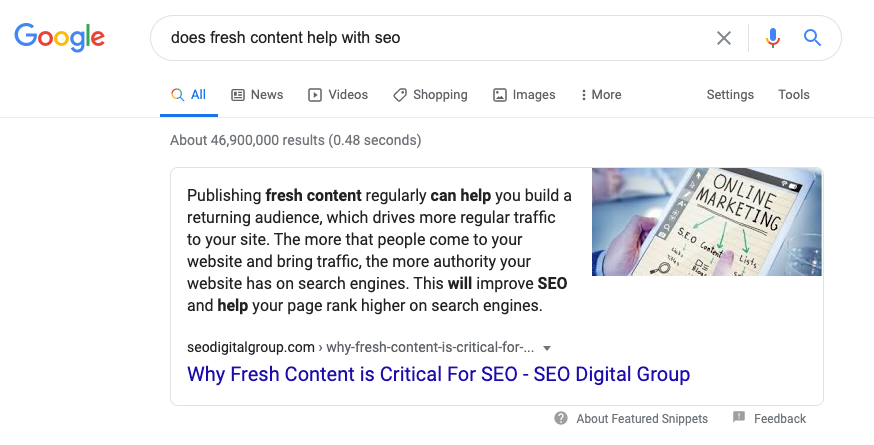
If you dig into the rest of the results on the front page you'll definitely be left with the impression that fresh content matters.
But like everything, its far more nuanced than that.
Let me explain.
What would fresh content be doing?
This idea of freshness applies to other channels as
All things being equal that's true; publish 10 pieces of content and you'll get more traffic than publishing 5 pieces of the exact same quality.
I'm using the term "quality" here pretty specifically to mean "quality according to search algorithms." This is likely pretty different from "quality according to your CEO."
You can read the leaked Google Quality Rater guidelines here for some insight into what Google thinks constitutes "quality content."
The downside of this fresh content approach, however, is that budgets are finite. Publishing more frequently necessarily means lower quality.
This is where I think the idea of fresh content usually steers people wrong.
From an SEO standpoint, you're FAR better off publishing once a month, but spending the time researching topics, keywords, the competition, and intent, and then publishing something longer, better, prettier, more interesting, etc, than you would be even publishing lower quality content every day.
In reality, most companies don't need much more than 10-20 pieces of really strong content around a given topic (service line, product category, etc) to dramatically improve visibility in the search engines.
That might even be on the high end.
So, if your content strategy includes search as a distribution channel, consider slowing down a bit, writing longer, more researched, more detailed pieces that are very tightly centered around the products and services you offer.
And try not to go too far outside of your wheelhouse because you could actually harm your search rankings.