10 Landing Page Design Best Practices to Maximize Conversions in 2026
DL
Dwayne Lynn
In performance marketing, a landing page is more than just a digital destination; it's a meticulously engineered tool designed for a single, focused purpose: conversion. Every pixel, word, and form field can either add to your bottom line or leak ad spend. Getting this right separates campaigns that deliver impressive ROAS from those that barely break even. But with user expectations constantly evolving and platform algorithms becoming more sophisticated, what worked last year might be costing you leads and revenue today.
Ready to see how your current strategy stacks up? Before you dive in, consider getting a complimentary, no-obligation audit of your marketing strategy from our senior team. We’ll identify your biggest opportunities for growth. Get Your Free Audit Here.
This guide moves beyond generic advice. We're breaking down the essential, revenue-focused landing page design best practices that our agency uses to turn clicks into customers. We will cover everything from strategic layout and compelling copy to the critical technical performance standards that impact your Quality Score and ad costs. You will learn how to implement a single, powerful call-to-action, establish trust with social proof, and design for a mobile-first world without sacrificing speed.
Each practice is a lever you can pull to directly influence performance, whether you are generating B2B leads, driving e-commerce sales, or launching a new product. The following list is a comprehensive blueprint for building high-converting assets that don't just look good, they perform.
1. Single Primary Call-to-Action (CTA) Above the Fold
One of the most impactful landing page design best practices is to present a single, dominant Call-to-Action (CTA) above the fold. This means the primary action you want a user to take is immediately visible without any scrolling. This approach is designed to eliminate decision paralysis and reduce cognitive load by giving visitors one clear, unambiguous path forward. For performance marketing teams, a singular focus on one conversion goal-whether it's a form submission, a purchase, or a demo request-is the fastest way to improve conversion rates and maximize return on ad spend (ROAS).
When a user lands on a page cluttered with multiple choices, they are less likely to make any choice at all. By consolidating user intent into a single action, you guide them directly toward the conversion point. Dropbox famously used this strategy with its classic "Sign Up" CTA, which was central to its massive user acquisition. Similarly, HubSpot's lead generation pages excel by featuring prominent form CTAs with minimal competing links or actions, ensuring the visitor’s attention remains fixed on the desired outcome.
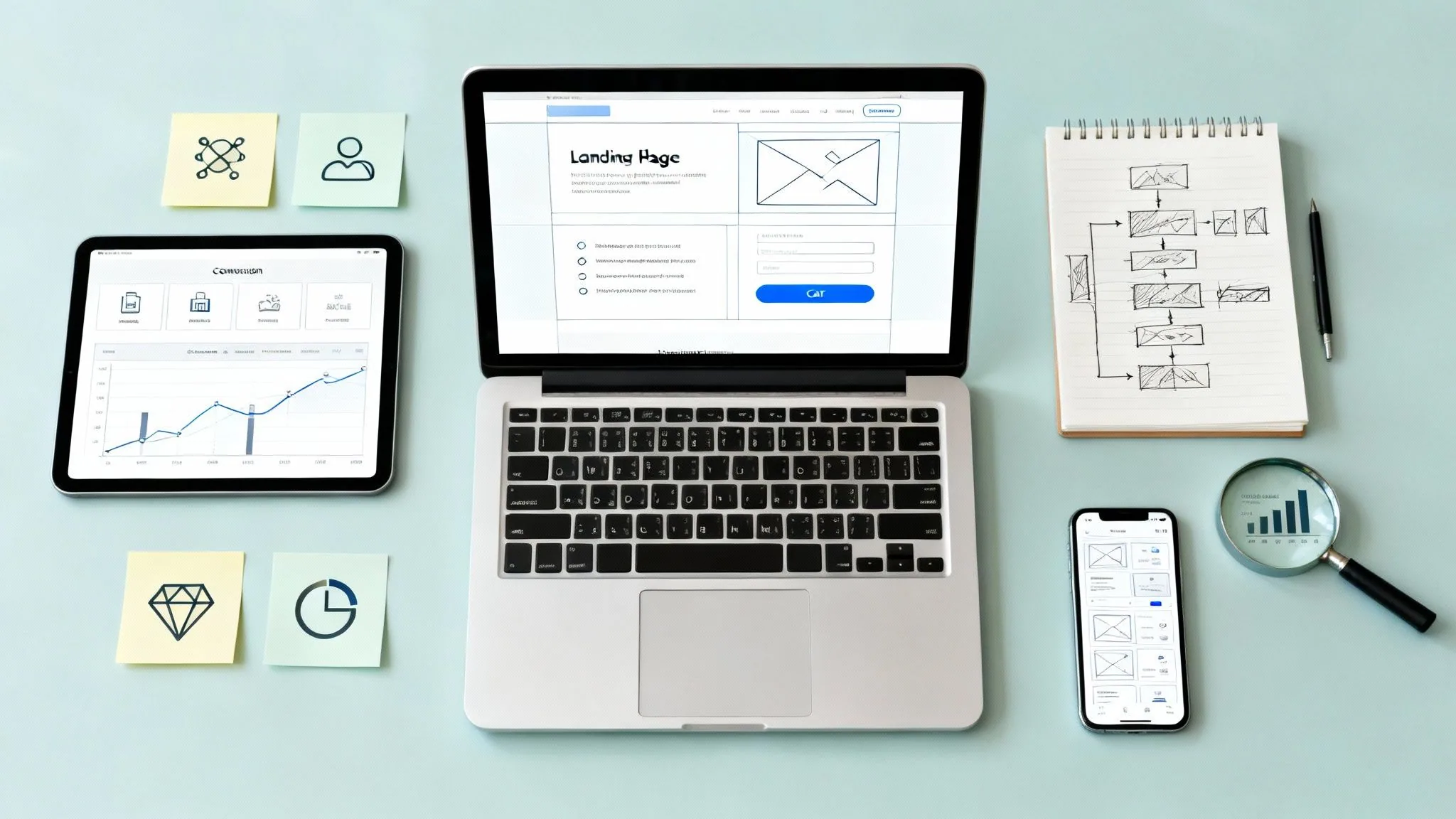
How to Implement a Single CTA Strategy
To effectively implement this strategy, focus on both visual prominence and message clarity. Your CTA should be impossible to miss and instantly understandable.
Use Contrasting Colors: The CTA button should stand out from the background and other page elements. Choose a color (like green, orange, or a vibrant brand color) that draws the eye but still feels cohesive with your overall design.
Test Your Copy: Don't settle for "Submit." Test action-oriented and value-driven variations like "Get Your Free Demo," "Claim My Discount," or "Download the Guide." The right copy aligns with the user's motivation and the specific offer.
Match Language to Intent: The CTA text should mirror the user's stage in the buyer's journey. "Learn More" is suitable for top-of-funnel awareness, while "Get a Quote" or "Start My Trial" is better for bottom-of-funnel, high-intent traffic.
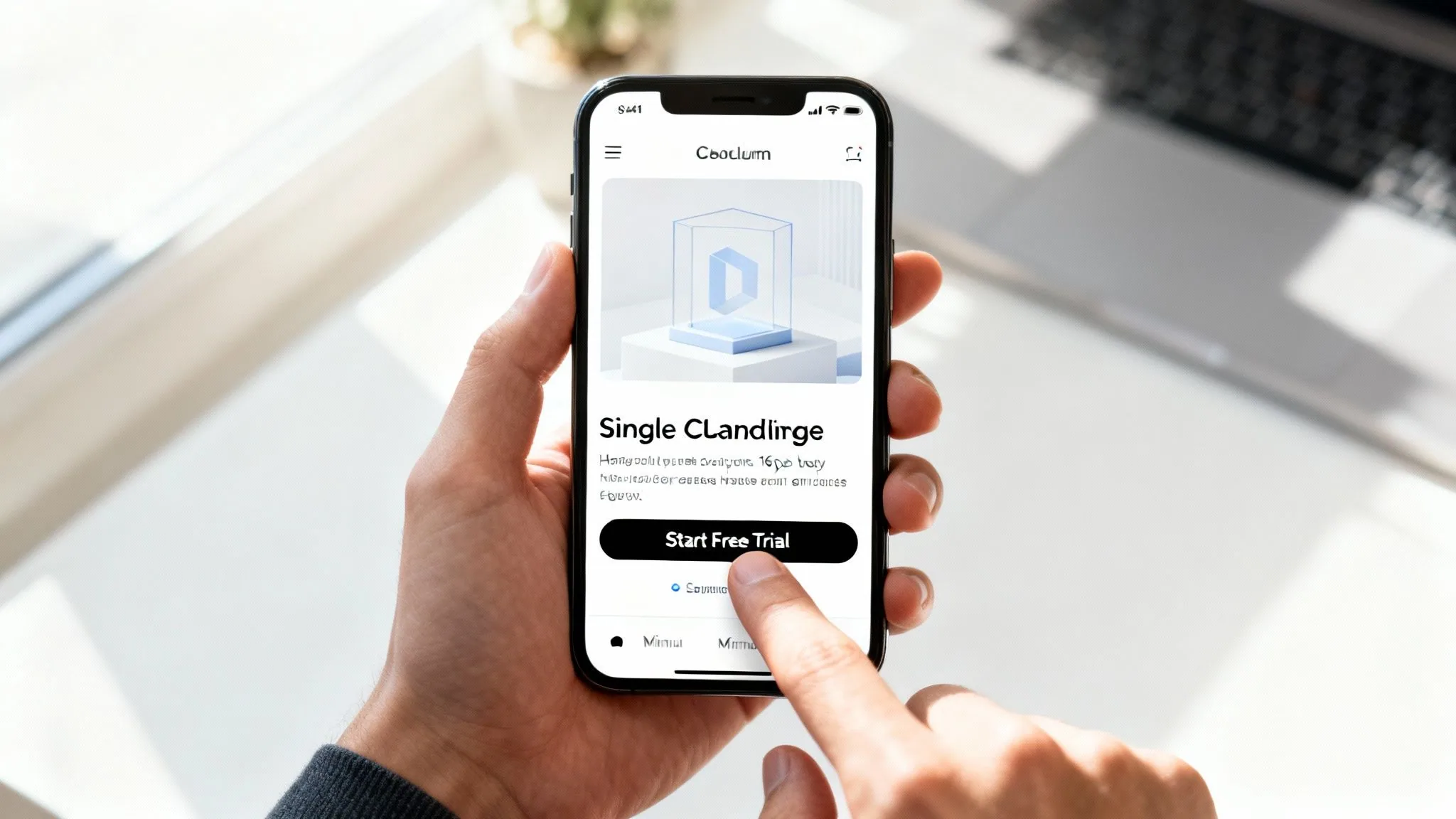
Leverage Sticky CTAs on Mobile: For users on smaller screens, a "sticky" CTA that remains fixed at the top or bottom of the screen during scrolling keeps the conversion action persistently visible and accessible.
2. Clear Value Proposition and Headline Hierarchy
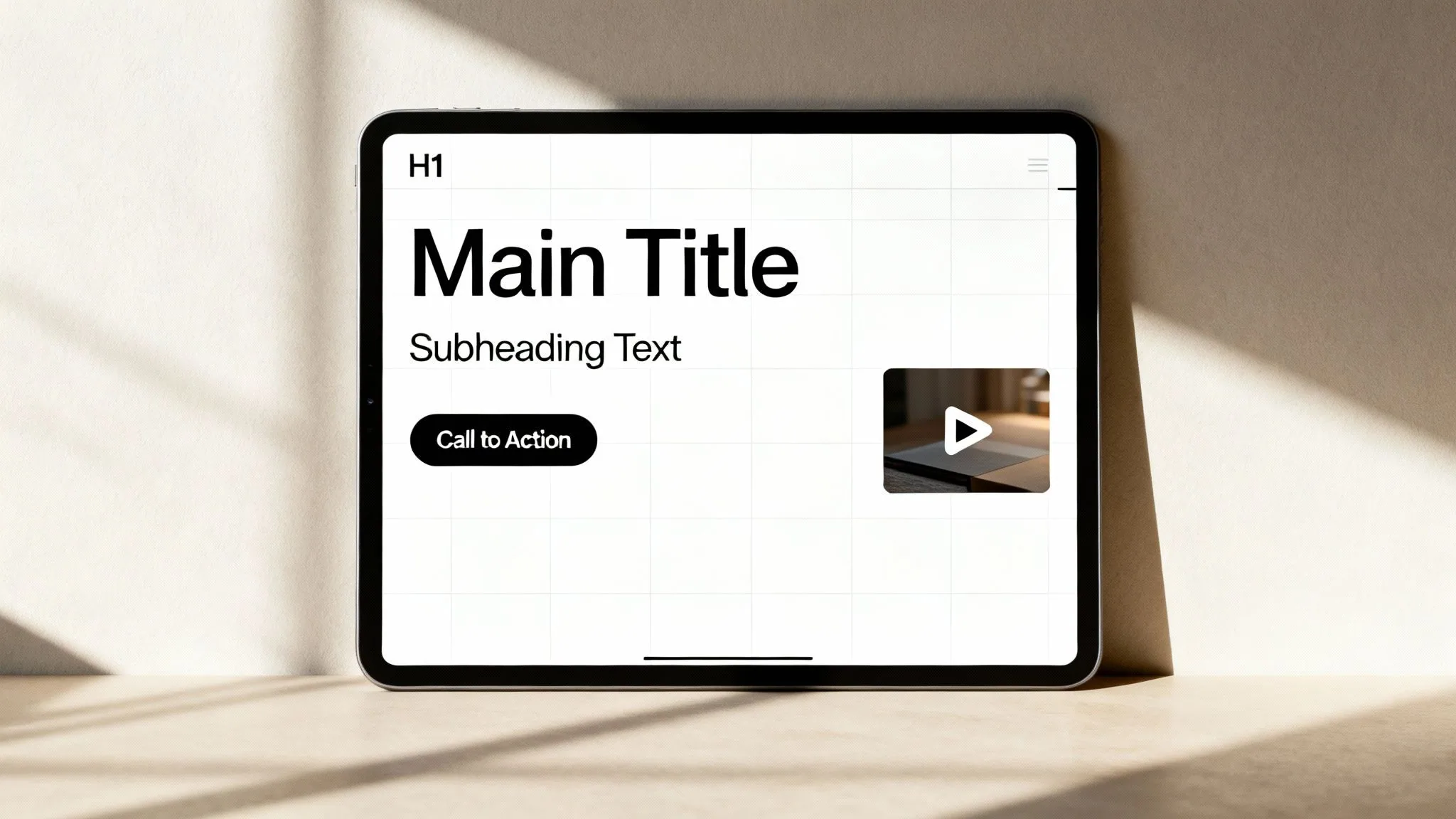
A compelling headline that immediately articulates your unique value proposition (UVP) is a cornerstone of effective landing page design best practices. The headline must answer the visitor's most pressing question, "Why should I care?" within the first few seconds. This is supported by a clear hierarchy of subheadings that expand on the core benefit, ensuring users grasp the offer's relevance before they even think about scrolling. For B2B and high-value B2C campaigns, a strong UVP is what separates a bounce from a conversion.
When a user arrives from an ad, they expect a seamless experience. Your headline must instantly confirm they are in the right place and reinforce the message that drove their click. A vague or feature-focused headline creates cognitive dissonance, leading to high bounce rates and a low Quality Score. Companies like Stripe excel here with headlines like "Payments infrastructure for the internet," which is clear, specific, and benefit-oriented. Similarly, Unbounce's classic "Landing Pages That Convert" focuses squarely on the desired outcome, not the software features.
How to Implement a Strong Headline Hierarchy
To craft a high-converting headline, you need to combine persuasive copywriting with a logical visual structure. This ensures your message is not just powerful but also easily digestible.
Align Headline with Ad Copy: Ensure your headline directly mirrors or logically follows the copy in the ad that brought the user to the page. This continuity is crucial for maintaining user intent and trust.
Use the PAS Framework: Frame your message using the Problem-Agitate-Solve model. Start by addressing the visitor's pain point, amplify the consequences of that problem, and then present your product or service as the ideal solution.
A/B Test Benefit Angles: Your audience may respond differently to various benefits. Test headlines that emphasize different value propositions, such as cost savings, speed, ease of use, or superior results, to identify what resonates most.
Incorporate Specificity and Numbers: Vague claims are forgettable. A specific headline like "Reduce Onboarding Time by 50%" is far more impactful and believable than a generic one like "Faster Onboarding."
3. Trust Signals and Social Proof Elements
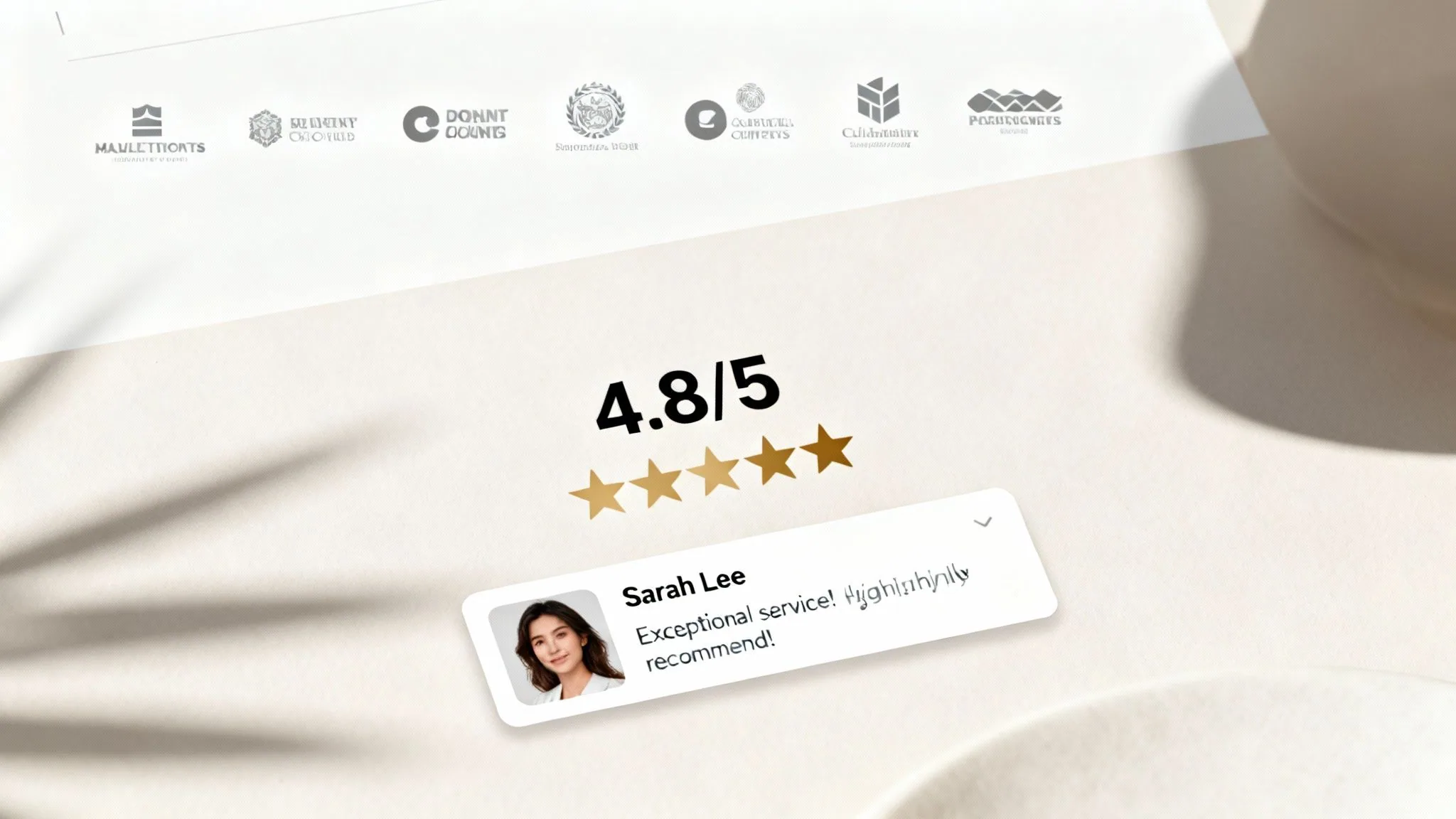
One of the most critical landing page design best practices involves strategically placing trust signals and social proof. These elements, including customer testimonials, case studies, security badges, and user counts, are designed to reduce visitor anxiety and perceived risk. For any brand, but especially those less known, building immediate credibility is essential for converting ad clicks into qualified leads or sales. By validating your claims through third-party endorsement, you answer the visitor's subconscious question: "Can I trust this company?"
This principle, famously detailed by Robert Cialdini, suggests that people look to the actions of others to guide their own behavior. HubSpot effectively uses this by displaying G2 Leader badges and a "Trusted by 150,000+ businesses" banner, providing immediate scale and authority. Similarly, Slack's prominent use of Fortune 500 client logos tells a powerful story of enterprise-level trust without a single word of copy. These signals act as a mental shortcut, assuring visitors that others have already made the right choice by choosing you.
How to Implement Trust Signals and Social Proof
To leverage these elements for maximum impact, integrate them naturally into the user's journey, placing them near key decision points like CTAs. The goal is to build a narrative of credibility from the moment a user lands on the page.
Quantify Your Proof: Be specific. A testimonial that says "We saw a 20% faster deployment time" is far more compelling than one that says "It's a great product." Use real numbers and metrics to build a stronger case.
Segment Your Signals: Rotate testimonials and case studies to match the visitor segment. If you're targeting the healthcare industry, feature logos and reviews from relevant healthcare organizations.
Place Strategically: Position your strongest social proof, such as a well-known client logo or a powerful video testimonial, above the fold. Place other trust signals, like security badges, near form fields or payment buttons to alleviate friction.
Prioritize Video: When possible, request video testimonials from happy customers. These are often perceived as more authentic and can deliver a message with greater emotional impact than text alone.
4. Mobile-First Responsive Design
With more than half of all web traffic now coming from mobile devices, a mobile-first approach is one of the most critical landing page design best practices for maximizing conversions. This means designing for the smallest screen first and then scaling up to desktop, rather than the other way around. A mobile-first strategy ensures that core elements like touch-friendly CTAs, fast load times, and legible typography are prioritized, preventing the high bounce rates and poor ROI that result from a clunky mobile experience. Google's mobile-first indexing further solidifies this, directly tying your mobile site's performance to your search ranking.
A poor mobile experience is a direct revenue leak. Companies like Stripe and Airbnb exemplify excellent mobile-first execution; their landing pages feature simplified layouts, vertical content flow, and prominent, thumb-friendly buttons that make conversion effortless. Similarly, HubSpot’s mobile forms use single-field progressive profiling to reduce friction, acknowledging that mobile users have less patience for lengthy data entry. The goal is to deliver a seamless, intuitive experience that feels native to the device, not like a shrunken-down desktop page.
How to Implement a Mobile-First Design
To execute a successful mobile-first strategy, you must shift your perspective from "mobile-friendly" to "mobile-native." This involves prioritizing speed, simplicity, and accessibility for on-the-go users.
Design for Thumbs: Place key navigation elements and CTAs within the "thumb zone" at the bottom or middle of the screen. Ensure buttons are large enough to be tapped easily without accidental clicks.
Prioritize Speed: Mobile users expect near-instant load times. Compress images, leverage browser caching, and consider using Accelerated Mobile Pages (AMP) to ensure your page loads in under three seconds.
Simplify Forms: Every form field adds friction and can reduce mobile conversions by 10-15%. Use single-column layouts, enable auto-fill where possible, and only ask for essential information. For lead gen, click-to-call CTAs (using tel: links) can often outperform forms.
Test on Real Devices: Browser emulators are useful, but they don't replicate the real-world user experience. Test your landing pages on actual iPhones, Android devices, and tablets to identify and fix usability issues.
5. Minimal Form Friction and Progressive Profiling
One of the most critical landing page design best practices for lead generation is minimizing form friction. Long, intimidating forms are conversion killers; every additional field you require creates a barrier that can drastically reduce submission rates. The goal is to make the initial conversion as effortless as possible by asking only for the absolute minimum information required to start a conversation, typically just an email address. For B2B and lead-gen campaigns, reducing unnecessary fields is a high-impact optimization that can directly increase qualified leads and lower cost-per-acquisition (CPA).
The solution is a strategy called progressive profiling, where you gather information in stages throughout the customer lifecycle. HubSpot championed this approach by using smart forms that recognize returning visitors and present them with new fields to collect more data over time. Similarly, LinkedIn’s Lead Gen Forms auto-fill user data, reducing the task to a single click. This incremental data collection method respects the user's time, builds trust, and allows you to build a comprehensive lead profile without overwhelming them at the crucial first touchpoint.
How to Implement Minimal Forms and Progressive Profiling
To successfully reduce form friction, combine a minimalist initial form with intelligent follow-up data collection strategies. This approach maximizes initial conversions while still enabling lead qualification.
Start with the Essentials: Your initial form should ideally ask for only an email address. If absolutely necessary, add a name field, but test a single-field form first. A/B tests consistently show that 1-field forms outperform 3-field forms significantly.
Use Conditional Logic: If you need more information for segmentation, use conditional fields that appear based on a user's previous answer (e.g., asking for "Company Size" after they select "B2B" as their industry).
Implement Post-Conversion Data Collection: Use the thank-you page to ask for more information. After a user has converted, they are more willing to provide secondary details like their phone number or company name in exchange for an upgraded offer or resource.
Automate Data Capture: Use hidden fields populated with UTM parameters to automatically capture the campaign source, medium, and term. This gives you valuable attribution data without adding a single field for the user to complete.
6. Visual Hierarchy, Whitespace, and Visual Demonstrations
One of the most foundational landing page design best practices is establishing a clear visual hierarchy, amplified by strategic whitespace and compelling visual demonstrations. This trifecta guides a user's attention through the page in a deliberate sequence, ensuring they see the most important elements-headline, value proposition, and CTA-in the right order. Whitespace, or negative space, isn't empty space; it’s an active design element that reduces cognitive load, improves readability, and makes your core message stand out. This approach prevents visual clutter and helps users process information effortlessly, accelerating their journey to conversion.
When combined with visual demonstrations like product videos or animated explainers, this principle becomes even more powerful. Instead of telling users about your solution, you show them. Apple’s product pages are a masterclass in this, using vast whitespace and stunning hero imagery to create a premium feel. Similarly, Slack’s landing pages feature short, engaging videos that demonstrate collaboration in action, making the benefits instantly tangible. These visuals reduce the mental effort required to understand an offer, making it easier for users to say yes.
How to Implement Visual Hierarchy and Demonstrations
To implement this strategy effectively, you must balance visual clarity with engaging storytelling. Your design should direct the eye, while your media should convey value quickly.
Follow the F-Pattern: Users naturally scan pages from top to bottom and left to right. Place your most critical information, like the headline and key benefits, along this path.
Leverage Whitespace: Use generous margins and padding (e.g., 16-32px) around key sections and elements. This creates visual separation and helps each component breathe.
Keep Videos Short and Focused: Aim for explainer videos between 60-90 seconds. Focus on a single problem-solution narrative and autoplay the video (muted) on a loop to capture attention immediately.
Use Visuals to Show, Not Just Tell: Instead of a long list of features, use annotated product screenshots like Mailchimp or short GIFs to demonstrate exactly how your product simplifies a user's workflow.
7. Compelling Copywriting with Benefit-Focused Messaging
High-impact landing page design best practices go beyond visuals; the copy is the voice of your page and the engine of conversion. Effective copywriting focuses on benefits, not features. It answers the user’s unspoken question, "What's in it for me?" instead of just listing what a product does. This benefit-led approach addresses user pain points directly, connects with their aspirations, and creates a compelling case for why they should convert. For any business investing in paid traffic, shifting from feature-centric to benefit-focused messaging is a direct lever for lowering customer acquisition costs (CPA) and increasing conversion value.
When copy fails to resonate, traffic is wasted. Benefit-focused messaging creates an immediate connection. For instance, Grammarly’s headline “Write with confidence” sells an emotional benefit, not a technical feature like an AI-powered grammar checker. Similarly, Slack promises users they can "Be less busy," a powerful outcome that resonates far more than listing its channel and integration features. This strategy, championed by legendary copywriters like David Ogilvy and Gary Halbert, ensures your message aligns perfectly with the user's core motivation, turning passive visitors into motivated customers.
How to Implement Benefit-Focused Copywriting
To transform your copy, consistently frame every statement from the customer's perspective. Your goal is to translate product attributes into tangible user outcomes.
Apply the 'So What?' Test: For every feature you list, ask, "So what?" Keep asking until you arrive at a core human benefit. "Our software has AI automation" (feature) becomes "So you can save 10 hours a week on manual tasks" (benefit).
Start with a Problem Statement: Hook visitors by articulating a pain point they instantly recognize. "Tired of juggling multiple spreadsheets?" is a powerful opener that validates their struggle and primes them for your solution.
Use Numbers and Specificity: Quantifiable benefits are more credible and compelling. Instead of "our tool is much faster," use "process invoices 40% faster." Specificity builds trust and makes the value proposition concrete.
Address Objections Proactively: Weave in copy that preemptively answers common doubts. Phrases like "No credit card required," "Cancel anytime," or "Trusted by 10,000+ businesses" remove friction and reduce conversion anxiety.
8. Fast Load Speed and Technical Performance
In the world of performance marketing, speed isn't just a feature; it's a foundational requirement for conversion. One of the most critical landing page design best practices is ensuring lightning-fast load speed and solid technical performance. Every millisecond a user waits for your page to load increases the likelihood they will bounce, wasting your ad spend and damaging your quality score. Pages that load in under 3 seconds have been shown to convert significantly better, directly impacting your ROAS and lead generation costs.
The financial impact of load time is well-documented. Amazon famously calculated that every 100ms of latency costs them 1% in sales. Similarly, when Walmart optimized its mobile pages to load in under one second, they saw a sharp increase in conversions. Google's own Core Web Vitals initiative has made page experience a key ranking factor, underscoring the importance of technical excellence not just for user experience but also for organic visibility. A slow landing page is a direct bottleneck to revenue, no matter how compelling the offer or design may be.
How to Optimize for Speed and Performance
Auditing and improving your landing page's technical health is a continuous process that pays significant dividends. Start by benchmarking your current performance and then implement targeted optimizations.
Audit Your Core Web Vitals: Use tools like Google PageSpeed Insights and GTmetrix to get a baseline score. These platforms provide actionable diagnostics on what's slowing your page down, from large images to render-blocking JavaScript.
Compress and Optimize Images: Images are often the biggest culprits for slow load times. Use tools like TinyPNG or ImageOptim to compress image files without sacrificing quality. Serve images in modern, efficient formats like WebP whenever possible.
Enable Caching and GZIP Compression: Work with your developer to enable browser caching and GZIP compression on your server. GZIP can reduce the size of your HTML, CSS, and JavaScript files by up to 70%, drastically cutting down load times.
Leverage a Content Delivery Network (CDN): A CDN like Cloudflare or AWS CloudFront stores copies of your landing page assets on servers around the world. This ensures that content is delivered to users from a location geographically closer to them, reducing latency. Beyond just optimizing the page itself, ensuring fast load speed and technical excellence also involves applying comprehensive WordPress SEO optimisation strategies to create a technically sound foundation.
9. Targeted Messaging and Audience Segmentation
A core tenet of modern landing page design best practices is moving away from a one-size-fits-all approach. Effective pages are tailored to specific audience segments, messaging variants, and buyer journey stages. This strategy acknowledges that different visitors have unique pain points, motivations, and levels of awareness, and addressing them directly is the key to unlocking higher conversion rates. For B2B and high-value B2C marketers, personalized messaging dramatically improves relevance and demonstrates a deeper understanding of the prospect's needs.
When a prospect lands on a page that speaks their language and addresses their specific challenges, it builds instant rapport and trust. Salesforce excels at this by creating distinct landing pages for SMB versus Enterprise clients, each with tailored messaging, features, and pricing. Similarly, Intercom personalizes pages by industry, showcasing vertical-specific use cases for SaaS, E-commerce, or Fintech companies. This targeted approach ensures the value proposition resonates immediately, preventing the bounce that often occurs with generic messaging.
How to Implement Audience Segmentation
To get started, focus on creating distinct experiences for your most valuable audience segments without overcomplicating your workflow.
Start with Key Segments: Don't try to personalize for ten different personas at once. Begin with 2-3 high-impact segments, such as Enterprise vs. SMB, a specific job function (e.g., Marketing vs. Sales), or by traffic source (e.g., Google Ads vs. LinkedIn Ads).
Use UTM Parameters for Tracking: Tag your campaign URLs with UTM parameters to identify the incoming traffic source. This allows you to serve a specific landing page variant to each cohort and accurately track their conversion rates in your analytics platform.
Leverage Dynamic Content: Instead of building dozens of separate pages, use dynamic content replacement tools. These tools can swap out headlines, images, or testimonials based on the visitor's industry, location, or the ad they clicked, personalizing the experience at scale.
Incorporate Segment-Specific Proof: Enhance credibility by featuring case studies, logos, or testimonials from companies within the target segment. A testimonial from a similar company is far more persuasive than a generic one.
10. Conversion Tracking, Testing, and Iterative Optimization
A high-performing landing page is never truly "finished." The most effective landing page design best practices involve treating your page as a dynamic asset that improves through continuous, data-driven optimization. By implementing rigorous conversion tracking, structured A/B testing, and an iterative improvement process, you can move beyond guesswork and make decisions that systematically increase conversions. For any business focused on revenue impact, this culture of testing is the key to unlocking compounding growth and maximizing return on ad spend.
This methodology is famously championed by companies like Amazon, which relentlessly tests every element of its user experience to drive incremental gains. Similarly, Netflix's dominance is partly fueled by its constant experimentation with everything from thumbnail art to CTA copy, ensuring its platform is perpetually optimized for subscriber growth. Platforms like Optimizely and ConvertKit have built entire businesses on this principle, empowering marketers to test hypotheses and validate changes with statistical confidence. Without measurement, all optimization efforts are simply speculation.
How to Implement a Data-Driven Optimization Cycle
Building an effective testing framework requires a systematic approach to tracking, hypothesizing, and analyzing results. This turns your landing page into a powerful conversion engine.
Establish Robust Tracking: Before testing, ensure your analytics are flawless. Set up specific GA4 conversion events for every key action, such as form submissions or demo requests. Use a consistent UTM parameter structure (utm_source, utm_medium, utm_campaign) to accurately attribute performance to its source.
Test One Variable at a Time: To achieve clean, actionable data, isolate the element you are testing. Run A/B tests on a single variable, such as the headline, the CTA button color, or the number of form fields, to understand its direct impact on user behavior.
Prioritize High-Impact Tests: Use a framework like ICE (Impact, Confidence, Ease) to prioritize your testing roadmap. Focus first on changes you believe will have the biggest impact and are easiest to implement, ensuring your resources are directed effectively.
Analyze Qualitative and Quantitative Data: Combine quantitative data from A/B tests with qualitative insights. Use heatmaps (like Hotjar) and session recordings (like Fullstory) to understand why users are behaving a certain way, uncovering friction points that data alone might miss.
From Best Practices to Best Performance
Navigating the world of landing page design can feel like trying to solve a complex puzzle. With countless variables influencing user behavior, it's easy to get lost in the details. However, the comprehensive list of landing page design best practices we've explored provides a clear, strategic map to guide your efforts. This isn't about simply following a checklist; it's about internalizing a new, performance-driven mindset where every design choice is intentional and measurable.
The journey from a good landing page to a great one is paved with a deep understanding of core principles. We’ve covered everything from establishing a singular, powerful Call-to-Action (CTA) to ensuring your value proposition resonates instantly. We’ve seen how trust signals and social proof build credibility, and why a mobile-first, responsive design is no longer an option but a necessity in today’s digital ecosystem. Each of these elements works in concert, creating a seamless and persuasive pathway for your visitors.
Turning Knowledge into Revenue
The true power of these best practices is unlocked when they are applied not as static rules, but as dynamic levers for growth. The most successful growth-focused brands, B2B lead generation machines, and high-scaling e-commerce retailers treat their landing pages as living assets, not as "set it and forget it" digital brochures.
Consider these key takeaways as your starting point for immediate action:
Clarity Over Cleverness: Your primary goal is to eliminate confusion. A visitor should understand what you offer, why it matters to them, and what to do next within seconds. This principle underpins everything from your headline and benefit-focused copy to your visual hierarchy and CTA design.
Trust is Non-Negotiable: In a crowded market, trust is your most valuable currency. Authenticity, conveyed through genuine testimonials, security badges, and clear contact information, directly addresses user anxiety and removes critical barriers to conversion.
Performance is a Feature: A slow-loading page is a broken page. Technical optimization isn't just an IT task; it's a fundamental aspect of the user experience. Every millisecond you shave off your load time is a direct investment in your conversion rate and return on ad spend (ROAS).
Ultimately, all of these best practices are designed to serve a single, unified purpose: creating a frictionless and persuasive journey for the user. When you remove friction from forms, clarify messaging for specific audience segments, and guide the user’s eye with intentional visual cues, you are executing on the core principles of user experience optimization. This user-centric approach is the common thread that ties all high-performing landing pages together.
Your Next Step: From Audit to Action
Your path forward begins now. Don't let this knowledge remain theoretical. Start by conducting a thorough audit of your most critical landing pages against the ten principles discussed in this article. Identify the single biggest opportunity for improvement, form a clear hypothesis ("By reducing our form from seven fields to three, we will increase lead submissions by 15%"), and launch your first A/B test.
This iterative process of testing, learning, and optimizing is the engine of sustainable growth. Each test provides valuable data, moving you closer to a design that not only follows best practices but consistently delivers the best performance for your unique business goals. Your landing page is the final, crucial step in your acquisition funnel; mastering its design is one of the highest-leverage activities you can undertake to drive meaningful revenue impact.