PPC for Lead Generation: ppc for lead generation that delivers real results
AL
Andrea Larsen
Are your PPC campaigns bringing in more expensive clicks than actual, high-quality leads? It’s a common frustration, and trust me, you're not alone. The fix usually isn't just tweaking your bids; it's about taking a step back to build a solid strategic foundation before you even think about launching a campaign.
If this sounds familiar and you feel like your efforts are hitting a wall, request a free audit of your marketing or PPC strategy. We'll dive in and show you exactly where the opportunities for improvement are.
Building Your Foundation for High-Quality Leads
I've seen it time and time again: pay-per-click campaigns fail before they even start because the crucial prep work was skipped. Jumping straight into Google Ads or LinkedIn without a clear strategy is like trying to build a house on a foundation of sand—it’s just not going to hold up. A truly effective PPC for lead generation strategy starts by defining what a "high-quality lead" actually means for your business, then creating a detailed blueprint to go out and find them.
This isn’t about just getting more people to fill out your forms. It’s about getting the right people to do it. The real goal here is to build a predictable, repeatable engine that feeds your sales pipeline with prospects who are genuinely a good fit and ready to talk. To do that, you have to shift your thinking from just chasing clicks to attracting qualified customers.
Defining Your Ideal Lead Profile
Before you spend a single dollar on ads, you have to get laser-focused on who you're trying to reach. A "lead" isn't just a name and an email. It's a person with specific problems, needs, and buying signals that make them a perfect customer for you.
Honestly, a deep understanding of your customer is the bedrock of everything. Get this wrong, and nothing else matters. We've seen firsthand how this one step can completely change campaign outcomes, which we detailed in our guide on how to know your customer and cut PPC costs by 62 percent.
When you're building out this profile, think about these key areas:
Demographics: For B2B, this is non-negotiable. What's their job title? What industry are they in? How big is their company?
Pain Points: What specific, nagging problem does your product or service solve for them? Get into their head.
Buying Intent: What are they typing into Google? What online behaviors tell you they're actively searching for a solution like yours right now?
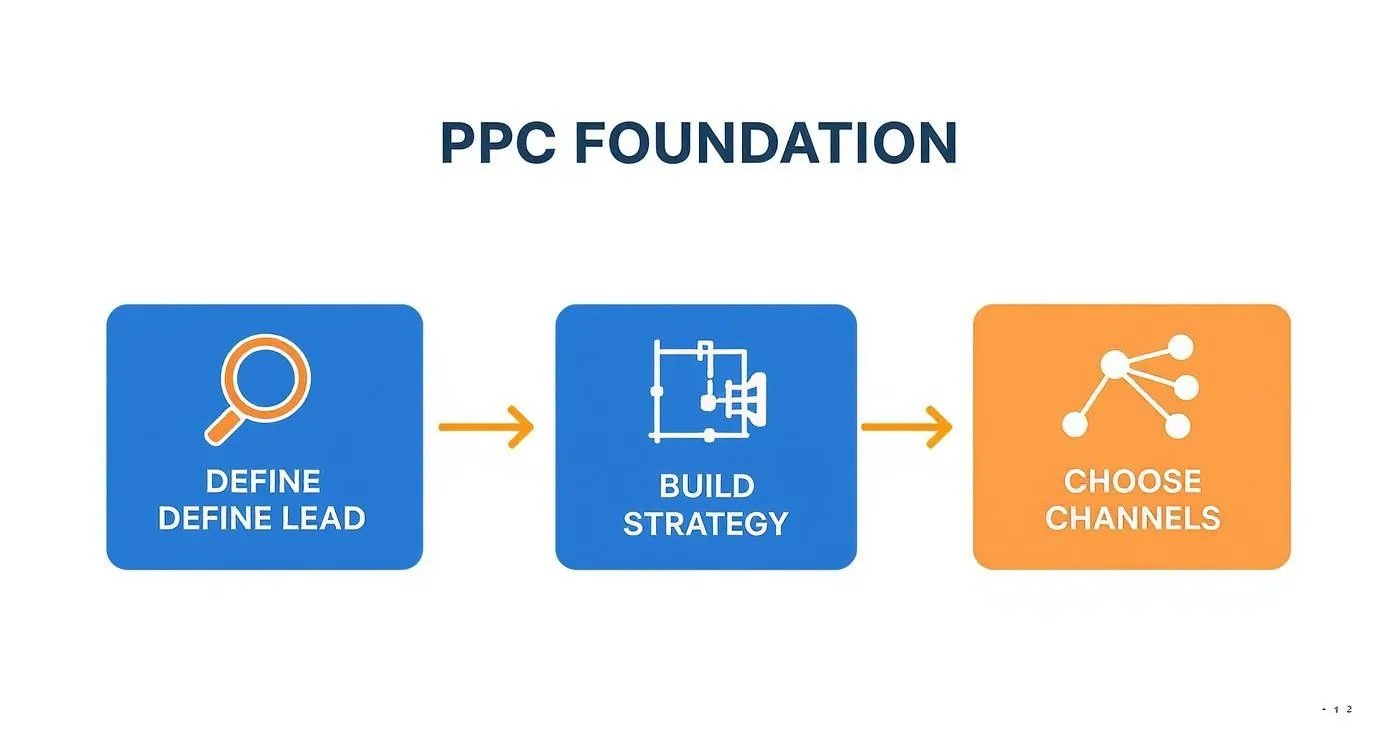
Nailing this down ensures your entire strategy—from the ad copy you write to the channels you pick—is perfectly aligned to attract that ideal person. The simple flowchart below shows how this foundational thinking sets you up for success.
As you can see, it's not random. It's a deliberate sequence: define the lead first, then build the strategy, and only then choose your channels.
The Power of a Strategic Blueprint
Once you have that crystal-clear lead profile, you can map out your strategic blueprint. This is what connects your big-picture business goals to your day-to-day campaign actions. It's the difference between blindly adjusting bids and proactively optimizing toward a specific, profitable outcome.
A PPC strategy without clear lead definitions is just a glorified guessing game. You might get some conversions, but you'll never achieve scalable, profitable growth until you know exactly who you're targeting and why.
Your blueprint should clearly outline how every part of your campaign will work in harmony. This means identifying the best platforms to find your audience, creating offers they can't refuse, and designing landing pages that turn a simple click into a real business opportunity. Each piece builds on the last, creating a powerful, cohesive system designed for one purpose: generating high-quality leads.
Feeling stuck on how to structure your PPC campaigns to actually generate leads? Our team lives and breathes this stuff. Request a free audit of your marketing or PPC strategy, and we’ll give you a clear roadmap for building a scalable foundation for success.
Choosing Your Channels and Structuring for Success
Alright, you've nailed down who your ideal lead is. The next big question is, where do they hang out online? The success of your entire PPC for lead generation strategy really boils down to this: showing up where your prospects are already looking for answers. It's not just about chasing traffic; it's about matching the platform's user intent with what you're trying to achieve.
For most businesses, Google Ads is the obvious first stop. Its search network is a goldmine for capturing high-intent users—people actively typing their problems into a search bar. This makes it a powerhouse whether you're a local plumber or a global software company.
But for B2B marketers, especially those navigating a longer sales cycle, you can't ignore LinkedIn Ads. While Google is great for capturing immediate intent, LinkedIn lets you target with surgical precision using professional data like job titles, company size, and specific industries.
Aligning Platform Strengths with Business Models
Deciding where to put your money requires you to think critically about your own business model. Let’s break it down with a couple of real-world scenarios.
Scenario 1: The B2B SaaS Company
Imagine you’re selling project management software to large construction firms. In this case, LinkedIn is your playground. Why?
Precision Targeting: You can build campaigns that only show ads to "Project Managers" or "VPs of Construction" at companies with over 500 employees. That kind of specific targeting just isn't possible anywhere else.
Content-Driven Approach: LinkedIn is built for sharing high-value content. It’s the perfect place to promote a detailed whitepaper or a webinar, which are fantastic tools for nurturing leads through a complex buying journey.
Scenario 2: The Local Home Services Business
Now, let's flip the script to a local roofing contractor. Their ideal customer isn't defined by a job title but by a sudden, urgent need. For them, Google Ads is the undisputed champion.
High-Intent Keywords: They can jump on keywords like "emergency roof repair near me" or "local roofing companies," catching homeowners right at the moment of crisis.
Geo-Targeting: They can draw a tight circle around their service area, ensuring every single ad dollar is spent reaching potential customers nearby.
The best channel isn’t always the biggest; it’s the one where your ideal customer’s mindset matches the platform’s context. Google is for finding answers and solutions, while LinkedIn is for professional networking and career development.
Building a Scalable Campaign Structure
Picking your platforms is just the first step. The real secret to long-term PPC success is hiding in plain sight: your account structure. A messy, disorganized account is a budget-killer that makes it impossible to figure out what's working. A logical structure, on the other hand, gives you control, clarity, and the ability to scale.
The goal is to create a hierarchy that mirrors your business and makes management and reporting a breeze. I've found the most effective approach is to organize campaigns around core themes, often reflecting user intent or different stages of the buyer's journey.
For example, you could set up distinct campaigns for:
Branded Search: To protect your turf and capture anyone searching for your company name directly.
Top-of-Funnel (Problem-Aware): Targeting broader, informational keywords related to the problems you solve.
Bottom-of-Funnel (Solution-Aware): Targeting high-intent, commercial keywords from people who are ready to make a move.
The Power of Tightly Themed Ad Groups
Drilling down one level further, you have ad groups within each campaign. The golden rule here is to use tightly themed ad groups (TTAGs). This simply means that every ad group should focus on a small, hyper-related cluster of keywords, all pointing to a specific set of ads and a perfectly matched landing page.
Instead of one giant "Roofing Services" ad group, you’d break it down.
Ad Group: Roof Repair: Keywords would be things like "roof repair service" and "leaky roof fix." The ads and landing page would all talk directly about repair.
Ad Group: New Roof Cost: Keywords here would be "cost of a new roof" and "roof replacement estimate." The creative and landing page would focus on getting a quote.
Ad Group: Shingle Replacement: Keywords like "replace asphalt shingles" would live here, with a page dedicated to that specific service.
This obsessive organization creates incredible relevance between what someone searches for, the ad they see, and the page they land on. This "message match" is exactly what platforms like Google reward with higher Quality Scores, which in turn leads to lower costs and better ad positions. It’s the true engine of efficient PPC for lead generation.
Mastering Keywords, Audiences, and Ad Creative
Alright, you’ve picked your channels and sketched out your campaign structure. Now comes the fun part: building the engine that actually drives your PPC for lead generation machine. This is where you connect with your ideal customers using precise keywords, smart audience layering, and ad copy that actually gets the click.
Getting this right is what separates campaigns that burn cash from those that deliver a predictable stream of qualified leads. It all starts by digging much deeper than a surface-level keyword list. You have to get inside your prospect's head and understand the exact words they type into that search bar.
Uncovering High-Intent Keywords
The best keywords are rarely the most obvious ones. Sure, broad, high-volume terms have a role, but the real money is made in the long-tail keywords. These are the longer, more specific phrases that signal someone is much further down the buying journey.
Think about it: a person searching "CRM software" is just window shopping. But someone searching "CRM for small manufacturing companies"? That’s a hot lead.
Your job is to build out a keyword list that captures people at different stages of their research.
Problem-Aware Keywords: These folks know they have a problem but aren't sure how to solve it yet. Think "how to track sales leads effectively."
Solution-Aware Keywords: Now they’re actively looking for solutions. You’ll see searches like "best sales CRM software."
Commercial-Intent Keywords: These are the bottom-of-funnel searches from people ready to make a move, like "Salesforce alternative pricing."
And don't forget the other side of the coin: a rock-solid negative keyword list. This is non-negotiable. It stops your ads from showing up for irrelevant searches, saving you a small fortune. A B2B software company, for example, would immediately add negatives like "free," "jobs," and "internship" to stop wasting money on the wrong clicks.
Precision Targeting with Layered Audiences
In today's PPC world, keywords are only half the story. The real power comes from layering audiences on top of your keyword strategy to get hyper-specific about who sees your ads. This is how you make sure the right message finds the right person at the perfect time.
It’s like adding filters. You start with a keyword, then you start applying audience criteria to really narrow the focus. You can mix and match different audience types for some seriously powerful combinations:
Remarketing Lists (RLSAs): This is your chance to talk to people who have already visited your website. You can get even more granular by segmenting them based on which pages they saw or actions they took.
In-Market Segments: This lets you tap into Google's data to find people who are actively researching products or services just like yours.
Custom Audiences: You can upload your own customer email lists or build lookalike audiences to find people who share traits with your best customers.
Imagine combining a high-intent keyword with a specific audience. You could show ads for "project management software" only to users Google has identified as being in the "B2B Software" in-market segment who haven't visited your site before. That's how you find new, highly qualified prospects.
While this precision is fantastic, don't get too restrictive. Sometimes, you need to cast a slightly wider net. It's crucial to understand when you should use broad match in your PPC strategy to discover valuable, unexpected search queries you can refine later on.
Crafting Ad Creative That Converts
Your ad is the final, critical piece of this puzzle. You can have perfect keywords and flawless audiences, but if your ad copy is boring, no one is going to click. Great ad creative is a mix of psychology, clear communication, and a call-to-action (CTA) that makes people want to act.
A high-performing ad almost always has these elements:
A Problem-Solving Headline: Jump straight to the user's pain point. If their search was "leaky roof fix," your headline better promise exactly that.
Benefit-Driven Descriptions: Don't just list what your product does; explain how it makes the customer's life better. Instead of "24/7 Support," try "Get Expert Help Anytime, Day or Night."
A Clear, Strong CTA: Tell people exactly what you want them to do next. Use action-oriented language like "Get Your Free Quote," "Download the Guide," or "Schedule a Demo."
Social proof works wonders, too. Mentioning how many happy customers you have or adding a snippet from a great review can build trust instantly and boost your click-through rates.
At the end of the day, generating leads is a top priority for 34% of companies, but a shocking 80% of those leads never convert into sales. That huge gap between a click and a customer is where great ad copy, supported by smart targeting, makes all the difference. Mastering this trio—keywords, audiences, and creative—is how you build a system that doesn't just attract clicks, but attracts the right clicks from people ready to become customers.
Feel like your landing pages are the weak link in your PPC campaigns? It happens more often than you think, and a few small tweaks could be the difference between a lead and a lost opportunity. Request a free audit of your marketing or PPC strategy, and we'll dive deep into your entire funnel, from the initial ad click right through to conversion.
Designing Landing Pages and Forms That Convert
You’ve done all the hard work to get the click. But here’s a tough truth I've seen play out countless times: even the most brilliant PPC campaign will fall flat if it sends traffic to a weak landing page. This is the moment of truth, the split second where a visitor decides to become a lead or just hits the back button.
Your landing page isn't just a cog in your PPC for lead generation machine; it's the most critical conversion point. The entire experience has to be seamless and persuasive. From the instant the page loads, that user needs to feel they’ve landed in exactly the right place. Any disconnect creates friction and doubt, which absolutely kills conversion rates.
The Anatomy of a High-Converting Landing Page
A truly effective landing page is a master of focus. It has one job and one job only: to get the user to take a specific action. This means stripping away all the noise. Ditch the navigation links to your main website and get rid of any other distracting elements. Everything on that page must support the single conversion goal.
From my experience, a winning page almost always includes these core components working together:
A Clear Value Proposition: Your headline needs to instantly tell visitors what they get and why it matters. This isn't the time for a clever slogan; it's about delivering a crystal-clear benefit.
Benefit-Driven Copy: Use concise bullet points and short, punchy paragraphs. Focus on explaining how your offer solves the user's problem. It’s all about the outcome, not just a list of features.
Compelling Visuals: A high-quality image or a short video that shows your product or service in action can communicate value far more quickly than paragraphs of text ever could.
Social Proof: Nothing builds trust faster. Include testimonials, snippets from case studies, or logos of clients people recognize. These elements reassure visitors they’re making a smart choice.
The single most overlooked element is message match. The headline and core message on your landing page must directly reflect the promise you made in your ad. If someone clicks an ad for a "free roofing estimate" and lands on a generic "home services" page, you've lost them. It's an instant credibility killer.
Optimizing Your Lead Capture Forms
That lead capture form is often the final hurdle. A clunky, intimidating form can scare people away, even if they're genuinely interested in your offer. The key is to reduce as much friction as possible and make submitting feel easy and safe.
Think of your form as a value exchange. You’re asking for their personal information, so the perceived value of what you're offering must outweigh their hesitation to share their data. For example, a detailed whitepaper might justify asking for a job title, but a simple newsletter sign-up probably doesn't.
Here are a few tips I've seen skyrocket form submission rates:
Keep It Short: Only ask for what you absolutely need to qualify or contact the lead. Every extra field you add is another reason for them to leave. You can always gather more data later in the sales process.
Use Trust Signals: Add a small privacy statement right below the form, promising users their info won't be shared. Including security badges or certifications can also build confidence.
Design a Clear Call-to-Action (CTA): Your submission button needs to pop visually and use action-oriented text. Instead of a boring "Submit," try something specific like "Get Your Free Guide" or "Request My Demo."
The right approach often depends on your industry. A B2B SaaS company might need more info upfront than a local plumber, and that's okay. The key is finding the right balance.
Lead Generation Cost and Effectiveness Across Key Industries
The table below provides a glimpse into how the average Cost Per Lead (CPL) and influencing factors can vary dramatically across different sectors. This comparison can help you benchmark your own efforts and understand the strategic thinking required to succeed in your specific market.
Industry
Average CPL
Key Influencing Factors
Technology/SaaS
$150 - $400+
Long sales cycles and high customer lifetime value justify asking for more qualifying information upfront, such as company size and job title.
Legal Services
$100 - $300
High-value cases mean firms can invest heavily in lead acquisition, but initial forms are kept short to reduce friction for users in distress.
Home Services
$25 - $100
Speed is critical. Forms are often minimal (name, phone, zip code) to capture urgent leads quickly. Competition is fierce and localized.
Healthcare
$75 - $250
Trust and compliance are paramount. Forms may require more information but must be paired with strong privacy assurances and clear value propositions.
As you can see, what works in one industry might be completely wrong for another. Understanding these nuances is crucial for building a PPC strategy that not only drives clicks but also generates high-quality, cost-effective leads.
Feeling like your PPC tracking and bidding strategies are a black box? An expert second opinion can often uncover some serious opportunities to boost your ROI. If you'd like us to take a look, request a free audit of your marketing or PPC strategy. We’ll show you how to turn that raw data into a real competitive edge.
Nailing Your Tracking and Bidding Strategy
Let’s be honest: without clean data, you're just lighting money on fire. The most brilliant ads and perfectly structured campaigns fall flat if you can’t accurately measure what’s actually working. Solid tracking is the absolute foundation of any successful PPC for lead generation campaign, turning your best guesses into a predictable science.
This isn’t just about counting form submissions, either. A truly insightful setup captures every single valuable interaction a potential lead has with your business. That complete picture is what lets you make smart, data-driven decisions that fuel real growth.
Build a Tracking System You Can Actually Trust
Your ultimate goal is to get a true picture of your campaign’s return on investment (ROI). To do that, you have to track a lot more than just the obvious stuff. Modern lead generation is messy and happens across multiple touchpoints, and your tracking needs to keep up.
This is where Google Tag Manager (GTM) becomes your best friend. Think of it as a central hub for all your tracking codes (or "tags"). It lets you deploy and manage them without bugging your developers to edit website code every time.
You need to be capturing a mix of valuable actions:
Primary Conversions: These are your bread and butter—the main goals like a "Request a Quote" form fill or a "Schedule a Demo" booking.
Secondary Conversions: Don't ignore these! They are powerful micro-conversions that signal genuine interest, like phone calls from your ads, live chat conversations, or key PDF downloads.
Offline Conversions: This is where the magic happens. Tracking what happens after the initial lead is submitted is crucial. By importing your CRM or sales data back into the ad platforms, you can finally see which keywords and campaigns drive actual revenue, not just tire-kickers.
One of the most powerful tools for this is Google's Enhanced Conversions. It uses hashed, first-party data to give you a much more accurate conversion count, even when cookies are blocked. To get a better handle on this, check out our guide on understanding Enhanced Conversions in Google Ads.
Choosing the Right Bidding Strategy
With rock-solid tracking in place, you can finally unleash the ad platforms' algorithms. Today’s automated bidding strategies are incredibly powerful, but remember: they are completely dependent on the quality of the data you feed them. Garbage in, garbage out.
The bidding strategy you pick should evolve as your campaign matures and gathers more data.
Manual CPC: The go-to for brand new campaigns. When you have zero conversion data, this strategy gives you maximum control to gather those initial learnings and establish a performance baseline.
Maximize Conversions: Once your campaign is consistently getting at least 15-20 conversions per month, it’s time to flip the switch. The algorithm will then focus on getting you the most leads possible within your daily budget.
Target CPA (Cost Per Acquisition): After running Maximize Conversions for a while, you'll have a good idea of your average cost per lead. Now you can use Target CPA to tell the algorithm the maximum price you’re willing to pay for each one, giving you more control over profitability.
The move from manual to automated bidding is a critical step in scaling your PPC lead gen. It lets the machine make thousands of real-time optimizations that no human could ever replicate, freeing you up to focus on the big-picture strategy.
Smart Ways to Manage Your Budget
Picking a bidding strategy is only half the battle. You also need to manage your budget intelligently to squeeze every bit of value from your ad spend. With costs always on the rise, this has never been more important.
Consider that the average cost per lead (CPL) for Google Ads is now around $70.11. Some industries, like legal services, can see a CPL as high as $131.63 from an average click cost of just $8.58. This just shows how critical it is to convert every click as efficiently as possible. You can explore more benchmarks like these in WordStream's detailed analysis.
To get the most out of every dollar, lean into these tactics:
Geo-Targeting: Don't just target an entire state or country. Get granular. Focus your budget on the specific cities, zip codes, or even small radius areas that you know produce your highest-quality leads.
Dayparting: Dive into your conversion data. You'll likely find that certain days of the week or times of day are far more profitable. Set up ad schedules to bid more aggressively during these peak hours and pull back when performance naturally dips.
By combining a robust tracking foundation with smart bidding and budget allocation, you create a powerful system that doesn't just generate leads—it does so in the most cost-effective way possible.
Not sure where to start with your PPC strategy, or just feel like your current campaigns are stuck in a rut? Request a free audit of your marketing or PPC strategy. We'll dig in and show you exactly where the opportunities are hiding.
Common Questions About PPC for Lead Generation
When you're diving into the world of PPC for lead generation, some questions always seem to come up. It's easy to get tangled up in the details of ad spend, performance metrics, and timelines.
This section cuts through the noise with clear, straightforward answers to the challenges I see marketers wrestle with most often. Getting this stuff right is the difference between a campaign that feels like a money pit and one that becomes a reliable engine for growth.
How Much Should I Actually Budget for a PPC Campaign?
There’s no magic number here. Instead of pulling a figure out of thin air, the smartest way to set a budget is to work backward from your business goals. This approach keeps your spending grounded in reality and tied directly to the results you need.
First, figure out your maximum allowable cost-per-acquisition (CPA). This is the absolute most you can spend to land a new customer and still be profitable. Next, you need a solid estimate of your landing page conversion rate. If you don't have your own data yet, using an industry benchmark of 2-5% is a perfectly fine place to start.
Let's walk through a quick example:
Your target CPA is $150.
You estimate your landing page will convert at 3%.
This means you can afford to pay up to $4.50 per click ($150 CPA x 3% CVR).
If your goal is to bring in 30 new leads a month, you can map out your budget from there. To hit 30 leads at a 3% conversion rate, you'll need 1,000 clicks (30 leads / 0.03 CVR). That translates to a starting monthly budget of $4,500 (1,000 clicks x $4.50 CPC).
Plan on running this test budget for at least 60-90 days. That gives you enough time to gather real-world data before you even think about scaling up.
What Are the Most Important Metrics to Track?
It’s incredibly easy to get lost in a sea of data. The key is to ignore the vanity metrics—like raw clicks and impressions—and zero in on the numbers that actually impact your bottom line.
For lead gen, a few key metrics tell almost the whole story. Focus your attention here:
Cost Per Lead (CPL): This is your north star. It tells you exactly how much you're paying for every single inquiry your campaign generates.
Conversion Rate (CVR): This shows how effective your offer and landing page are. A consistently low CVR is a huge red flag, often pointing to a poor "message match" between what your ad promises and what your landing page delivers.
Lead Quality Rate (SQL %): This is, without a doubt, the most important metric of all. You absolutely must work with your sales team to find out what percentage of your PPC leads are turning into Sales Qualified Leads (SQLs). This number reveals if you're attracting the right people or just generating noise.
A campaign can have a fantastic CPL and a high CVR, but if none of those leads ever turn into real sales opportunities, the whole thing is a waste of money. Tracking lead quality is non-negotiable.
How Long Does It Really Take to See Results?
PPC is fast, but it's not magic. While you can start getting traffic and clicks almost immediately, achieving a consistent, profitable flow of high-quality leads takes time. It’s so important to set realistic expectations from the get-go so you don't pull the plug too early.
You need to plan for an initial 30-90 day "optimization phase." During this critical period, you're not just running ads; you're investing in data. This is when you'll discover your winning ad copy, build out your negative keyword lists, test different landing pages, and give the ad platform's algorithms time to learn.
You might get some great leads in the first week, and that's fantastic. But sustainable, scalable success requires patience. Think of those first three months as a necessary investment that will pay dividends for years to come.
Should We Hire an Agency or Keep It In-House?
This is a big one. The right answer usually comes down to three things: your team's expertise, their available time, and the complexity of your campaigns.
Managing PPC in-house can work well if you have a dedicated marketer with proven experience and your campaigns are fairly straightforward. But that’s often not the case.
Bringing in a specialized agency becomes the smarter move if you:
Lack deep, hands-on expertise in modern PPC strategies.
Are short on the time required for daily monitoring and optimization.
Need to run complex campaigns across multiple channels like Google, LinkedIn, and social media.
A great agency does more than just manage bids. They bring strategic insights, advanced tools, and battle-tested experience from hundreds of other accounts. That outside perspective can deliver an ROI that far outweighs their fee, putting you on the fast track to profitable lead generation.
If you're ready to see what a dedicated team of PPC experts can do for your lead generation, get in touch with us. We offer a free, no-obligation audit of your current strategy to identify your biggest opportunities for growth. Contact us today to get started.