


"Inbound marketing" has been getting a lot of coverage lately and you've probably run across the term at some point. So what is inbound marketing exactly, and is it really that great?
Origination
Hubspot invented the term "inbound marketing." It's nothing new, but Hubspot is unbelievably good at marketing so the term has exploded in popularity.
Here's a diagram that illustrates how Hubspot defines inbound marketing:
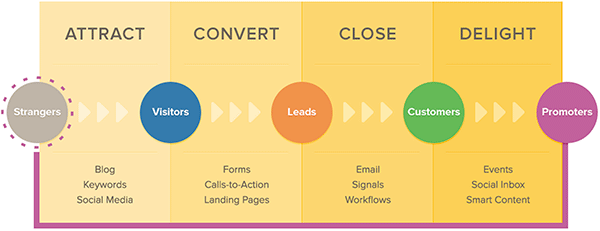
So there is literally nothing here except content, SEO, email, and social media, plus methods of collecting leads and measuring results.
Don't get me wrong, all the above things are awesome tactics and can be extremely effective if executed properly. But I really want to use this post to get past all the hype and explore what "inbound" really means.
Inbound Marketing = Content Marketing + Measurement
When people refer to "inbound marketing" they're talking about marketing activities that bring customers in – such as SEO & content marketing – rather than reaching out to grab customers – such as telemarketing, tv advertising, etc.
In reality, I'm not sure there's much of a difference. Inbound evangelists consider writing blog posts and optimizing them for search rankings to be inbound marketing. On the other hand, most probably wouldn't consider running display ads to drive traffic to that same content a form of inbound marketing.
But with SEO & content, you're still "reaching out" by writing content and optimizing for search. The only difference is you're "reaching out" through a channel where a larger portion of people are actually looking for the content you're promoting. That's just the nature of the channel – it's still marketing and it's still about exposure.
Now run banner ads for that same content. A banner ad is still "reaching out" and, presumably, if you're generating conversions people are interested in your content. The only difference is, in all likelihood, a larger percentage of people viewing your ad are not interested in your content.
Call it whatever you want: inbound, outbound, if it's generating a reasonable ROAS while holding true to your brand then it's working.
Don't pigeon-hole your marketing efforts
So don't pigeon-hole your marketing efforts by thinking Hubspot's version of "inbound" is the best way to market a business.
Marketing works best when it's multi-channel. Use direct mail, telemarketing, direct mail, tv & radio, trade shows, but also mix in a good bit of content marketing and measurement.
Content marketing combined with traditional approaches such as display ads, radio, or tv can be incredibly effective and generate much stronger ROAS than any one channel by itself. The key is to find the right marketing mix for your industry.