

Marketing attribution is really just a way of connecting the dots. It’s the practice of figuring out which marketing efforts—an ad, a blog post, an email—actually get credit for a sale or conversion. Instead of just guessing what works, attribution gives you a data-backed picture of what's driving results.
Struggling to figure out which marketing channels are actually driving your sales? A free audit of your marketing strategy can pinpoint which touchpoints are truly valuable. Contact us today to schedule your free audit and get clarity on your campaign performance.
Understanding Marketing Attribution and Why It Matters
Think about a typical customer journey today. It's rarely a straight line. A person might first discover your brand through a social media ad, later see a retargeting ad, get an email, and then finally type your website into their browser to make a purchase. Attribution helps you make sense of that entire path, not just the last step.

Without it, you're flying blind. You might pour money into channels that seem effective on the surface but are really just the final click in a much longer journey. By implementing a solid attribution model, you can confidently optimize your budget, prove marketing's value to stakeholders, and get a much clearer understanding of how customers find and interact with your brand.
Key Benefits of Marketing Attribution
To put it simply, attribution helps you make smarter decisions. Here's a quick breakdown of the major advantages you can expect.
| Benefit | Business Impact | Example |
|---|---|---|
| Optimized Marketing Spend | Allocates budget to the most effective channels, reducing wasted ad spend. | Shifting funds from a low-performing display ad campaign to a high-converting organic search keyword. |
| Improved ROI | Directly links marketing activities to revenue, making it easier to prove the value of your efforts. | Demonstrating that for every $1 spent on email marketing, you generate $5 in sales. |
| Enhanced Customer Insights | Reveals the complete path-to-purchase, showing how different channels work together. | Discovering that your customers often first engage with a video ad before converting via an email campaign. |
| Personalized Experiences | Allows for more relevant messaging based on a customer's previous interactions. | Showing a specific offer to a user who has visited your pricing page multiple times. |
| Better Strategic Decisions | Provides the data needed to make informed choices about future campaigns and strategies. | Using attribution data to justify investing in a new content marketing initiative for top-of-funnel awareness. |
Ultimately, adopting an attribution model moves your strategy from being based on assumptions to being driven by real, actionable data.
A Practical Comparison of Attribution Models
Deciding on an attribution model is a critical step in understanding your marketing performance. Each model assigns credit for a conversion in a different way, which in turn highlights different stages of your customer's journey. The models range from straightforward single-touch approaches to more sophisticated multi-touch systems.
Single-touch models, like First-Touch and Last-Touch, are the simplest to understand and implement. The First-Touch model gives 100% of the credit to the very first interaction a customer has with your brand. This is great for figuring out which channels are best at generating initial awareness. On the flip side, Last-Touch attribution assigns all the credit to the final touchpoint before the sale, putting all the focus on what ultimately closes the deal.
Of course, most buying journeys are more complicated than that. This is where multi-touch attribution (MTA) comes in, a concept that's been around since the late 1990s to help track complex user paths. A popular MTA model is Position-Based (also known as U-shaped), which gives 40% of the credit to the first touch, another 40% to the last touch, and spreads the remaining 20% across all the interactions in between.
Common Attribution Models at a Glance
To help you decide which model might work for you, here’s a quick-reference table. It breaks down how the most common models work, their pros and cons, and where they tend to fit best.
Comparison of Marketing Attribution Models
| Attribution Model | How It Works | Pros | Cons | Best For |
|---|---|---|---|---|
| First-Touch | Gives 100% credit to the first marketing interaction. | Simple to implement; highlights top-of-funnel channels. | Ignores all subsequent interactions that nurture the lead. | Businesses focused heavily on demand generation and brand awareness. |
| Last-Touch | Gives 100% credit to the final interaction before conversion. | Easy to track; clearly identifies conversion channels. | Overlooks the channels that initiated the customer journey. | E-commerce with short sales cycles and impulse buys. |
| Linear | Distributes credit equally across all touchpoints. | Provides a balanced view by valuing every interaction. | Can undervalue key touchpoints by treating them all the same. | Companies that want to maintain brand presence throughout a long sales cycle. |
| Time-Decay | Gives more credit to touchpoints closer to the conversion. | Reflects that recent interactions may have more impact. | Can devalue important early-stage, awareness-building efforts. | B2B marketing with long consideration phases where recent touchpoints are crucial. |
| Position-Based | Gives 40% to the first touch, 40% to the last, and 20% to the middle. | Balances the importance of both opening and closing channels. | The fixed percentages (40/20/40) are arbitrary and may not fit all journeys. | Businesses that value both the initial contact and the final conversion driver. |
This table should give you a solid starting point. Remember, no single model is perfect for every business. The best choice depends entirely on your sales cycle, marketing strategy, and overall business goals.
The Evolution of Marketing Measurement
If you want to really get a handle on what marketing attribution is, you have to look at where it came from. The central problem—tying your marketing dollars to actual revenue—is as old as marketing itself. Long before digital analytics existed, the sharpest minds in the business had to get creative to figure out what was actually driving sales.
This challenge pushed them toward the first real statistical methods. You can trace the DNA of modern attribution all the way back to the 1950s and the invention of marketing mix models (MMMs). This was a huge leap forward, giving companies a way to analyze how traditional media like TV, radio, and print ads were actually moving the needle on revenue. It was really the first organized attempt to replace gut feelings with data.
For a deeper dive on how these early ideas developed, check out the historical importance of marketing attribution. It’s these foundational concepts that paved the way for the sophisticated, multi-touch attribution systems we rely on now.
How to Implement Your Attribution Strategy
Putting an attribution strategy into action all comes down to having a solid technical foundation. And that foundation starts with clean, consistent data. The absolute first thing you need to lock down is a standardized system for UTM parameter tracking across every single digital campaign you run.
This means every link you share, whether it's in a social media post or an email newsletter, must carry specific, structured information about its source, medium, and campaign. Think of this data as the fuel for your attribution model—without it, the engine won't run.
You can get this done pretty easily with tools like Google’s Campaign URL Builder.
This handy tool helps you create properly tagged URLs, which is crucial for your analytics platforms to accurately trace where your traffic and conversions are coming from.
Once your links are in order, the next step is to get your tracking pixels and tags deployed on your website, often using Google Tag Manager. It’s a game-changer for managing these tracking codes without constantly bugging your developers. Getting your tagging right ensures you’re capturing every critical user interaction, from a simple page view to a completed form submission, feeding that rich data right back into your analysis.
Choosing the Right Attribution Model for Your Business
Picking the right attribution model isn't about finding a single perfect answer. Instead, it’s about choosing a framework that lines up with how your business actually operates. The best model for you really comes down to your sales cycle, how complex your customer journey is, and what you’re trying to achieve with your marketing.
There’s no magic bullet here. The goal is to select the model that gives your team the most useful, actionable insights to work with.
For example, an e-commerce brand with a quick and straightforward sales process might get everything it needs from a Time-Decay model. This approach rightly gives more credit to the touchpoints that happen right before the sale.
On the other hand, a B2B company with a long, drawn-out sales funnel will get a much clearer picture from a Position-Based or Linear model. These methods do a better job of recognizing the value of interactions all across the customer's journey, not just at the end.
To help you get started, this decision tree offers a simple way to think about which model might fit, based mainly on the length of your sales cycle.
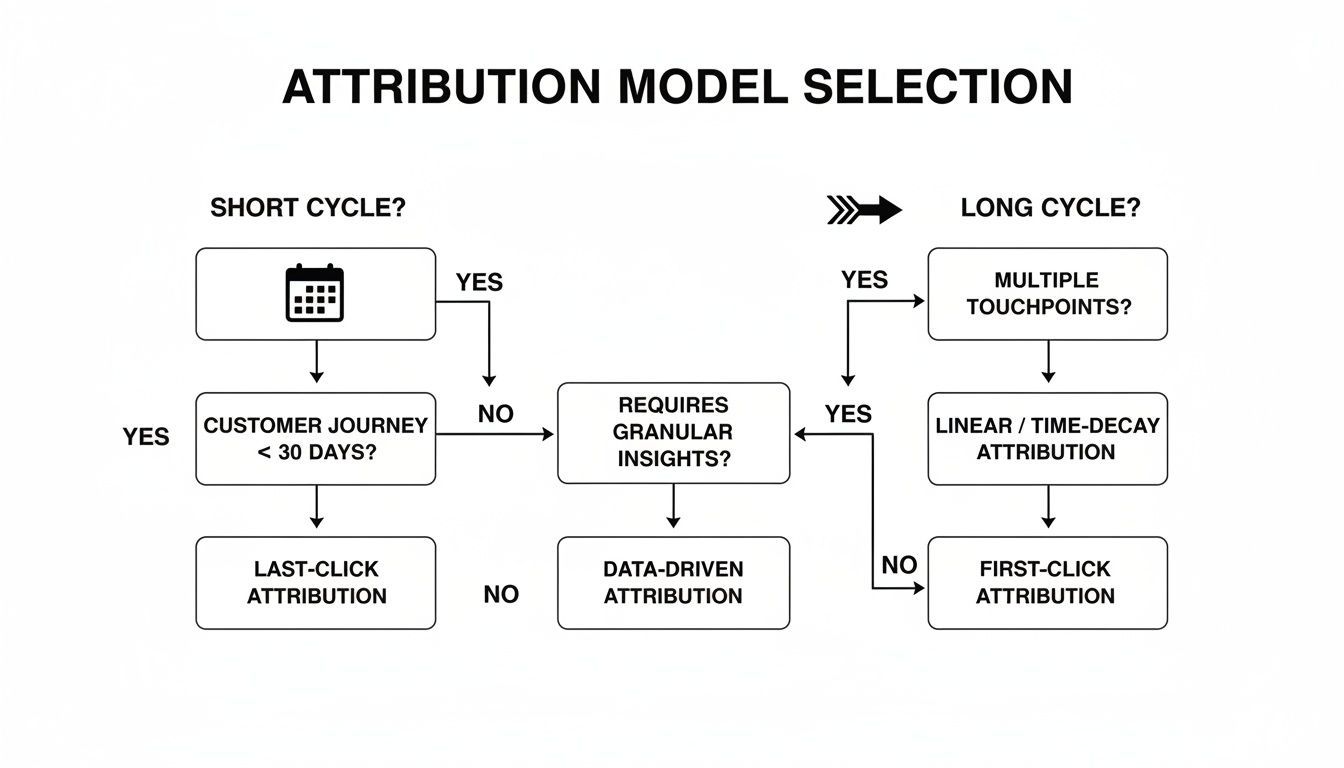
As you can see, businesses with shorter cycles often find that models like Last-Touch or Time-Decay are sufficient. But for those with longer, more involved journeys, a multi-touch model is almost always the better choice to capture the full story.
Essential Platforms for Your Attribution Tech Stack

True marketing attribution is only as good as the technology you use to track it. You need a solid tech stack that can pull together data from every corner of your marketing efforts. If your platforms don't talk to each other, you're left with siloed information and an incomplete picture of what’s really working.
Building a powerful stack means picking the right tools and making sure they integrate seamlessly. Each platform has a specific job, from tracking that first ad click all the way through to the final sale.
Core Attribution Technologies
Here's a breakdown of the must-have tools for any serious attribution setup:
Web Analytics Platforms: This is your foundation. A tool like Google Analytics 4 (GA4) is non-negotiable for tracking website activity, monitoring conversions, and using basic attribution models to see how different channels contribute.
Customer Data Platforms (CDPs): A CDP is the central hub for all your customer data. It pulls information from multiple touchpoints—your website, app, CRM, and more—to create a unified profile for each user, giving you that single source of truth.
Ad Platform Tools: Every major ad network, from Google Ads to Meta Ads, has its own built-in attribution reporting. This is critical for getting a granular view of campaign performance within those specific ecosystems. For a closer look at how this works on the ground, check out our guide on understanding enhanced conversions in Google Ads.
Mobile Measurement Partners (MMPs): If you have a mobile app, you absolutely need an MMP. These platforms are purpose-built to attribute app installs and in-app actions back to the specific campaigns that drove them, a task that standard web analytics tools can't handle.
Your Top Marketing Attribution Questions Answered
Even with a solid plan, it's natural for questions to pop up about what marketing attribution really means day-to-day. We get these all the time. Let's tackle some of the most common ones to clear things up and give your team some practical next steps.
What’s the Difference Between Marketing Attribution and MMM?
People often use these terms interchangeably, but they're fundamentally different tools for measuring marketing impact. Marketing attribution is all about the individual customer journey. It works at the user level, connecting the dots between specific touchpoints—like an ad click or an email open—and a final conversion.
Marketing Mix Modeling (MMM), on the other hand, takes a much broader, top-down view. It's a statistical analysis of aggregate data over time, showing how entire channels (including offline ones like TV or print) contribute to your overall sales. Think of it this way: attribution is the microscope, giving you a detailed look at individual paths, while MMM is the telescope, showing you how the big pieces fit together.
How Can I Start With Attribution on a Limited Budget?
You don't need a massive budget or a fancy new tool to get started. The single most important thing you can do is nail the fundamentals. Start by implementing a consistent UTM tracking strategy across every single campaign you run.
From there, you can use a free, powerful tool like Google Analytics 4 (GA4) to get your feet wet. GA4 comes with several built-in attribution models—like last-click, first-click, and linear—that you can use right out of the box. Just switching the reporting view between these models will give you some eye-opening insights into how different channels get credit. This simple analysis is often enough to start understanding your customer journey better before you ever spend a dime on more advanced software.
How Have Privacy Changes Affected Attribution?
There's no sugarcoating it: privacy changes have thrown a wrench in the works. Regulations like GDPR and platform updates from Apple have made user-level tracking much harder. With third-party cookies disappearing and consent being more tightly controlled, traditional multi-touch attribution models often struggle to see the full picture, leading to gaps in the data.
But the industry is adapting. We're seeing a major shift toward more privacy-friendly methods. This means a renewed appreciation for aggregate approaches like MMM and a huge push to collect first-party data directly from customers. Technologies like server-side tagging and conversion APIs are also becoming standard practice to help maintain data accuracy while fully respecting user privacy.