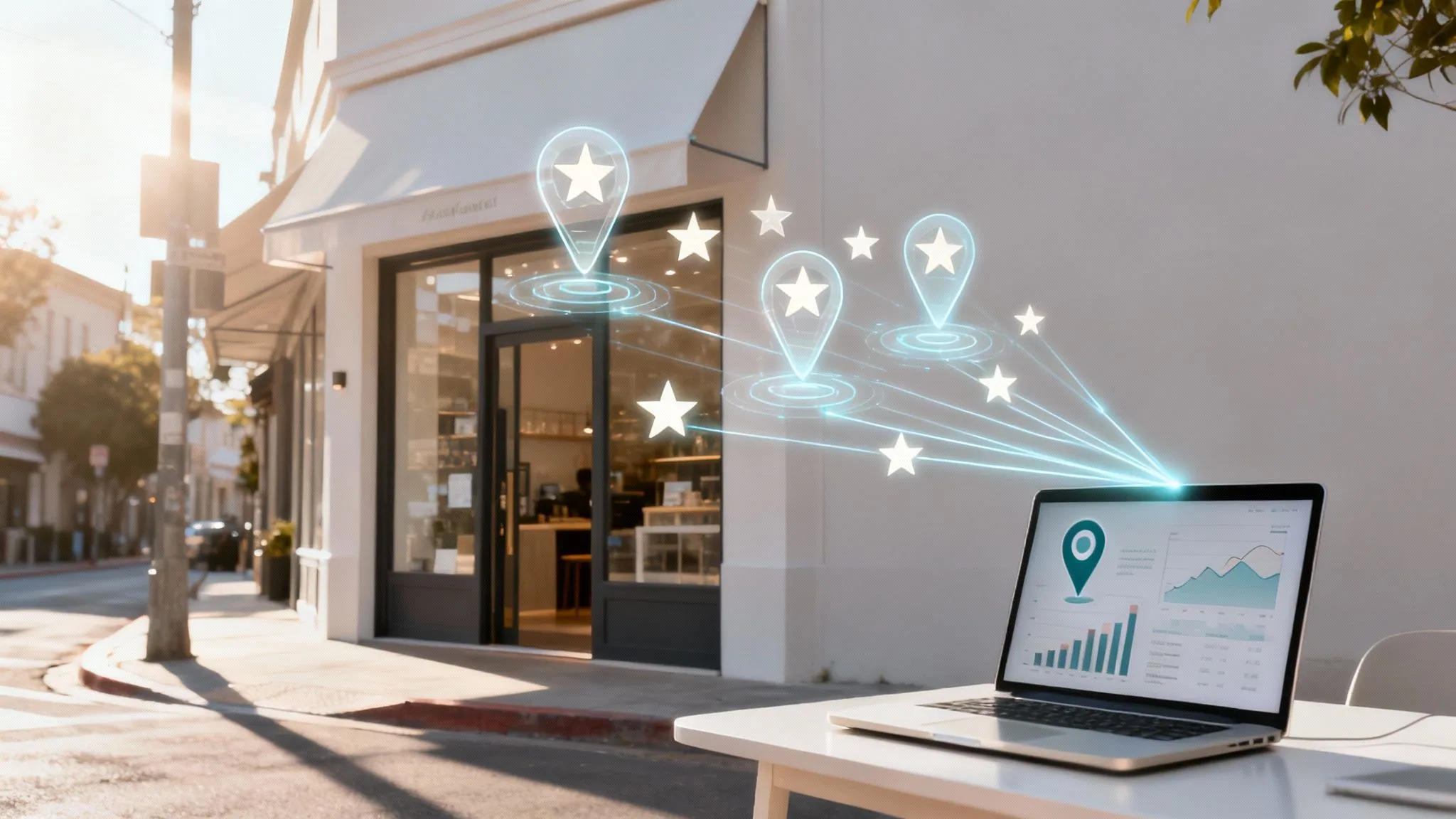
Franchise marketing is a unique beast. At its heart, it’s a partnership where a national brand-the franchisor-sets the overall vision and provides the tools, while local owners-the franchisees-bring that vision to life in their own backyards. It’s this delicate balance between brand-wide consistency and local market relevance that creates a powerful, seamless experience for customers, no matter where they are.
Curious if your current marketing or PPC strategy has what it takes to grow? Request a free audit today and get an expert analysis of your approach.
Think of franchise marketing as a team effort. The franchisor is like the architect of a massive skyscraper. They provide the master blueprint, define the structural standards, and source the high-quality materials. The individual franchisees are the skilled builders on the ground, constructing each floor. They follow the architect's core design but adapt their methods to the specific terrain and conditions of their location.
This entire model was born from a fundamental business problem: how do you grow a brand across hundreds or even thousands of different communities without watering down its identity? The answer lies in creating a system where the whole is truly greater than the sum of its parts.
The Power of Two Engines
The best franchise marketing runs on two engines, working in perfect sync. This dual approach is what drives both broad brand awareness and deep community connection.
The National Engine (Franchisor): This is all about the big picture. They focus on building brand equity, launching major advertising campaigns, and creating the core marketing assets that everyone recognizes.
The Local Engine (Franchisee): This engine is focused on ground-level impact. Franchisees are responsible for connecting with their community, running targeted local ads, managing their location's online reputation, and ultimately, getting people in the door.
This structure allows a national brand to project a strong, consistent message while empowering local owners to speak the language of their customers. There’s a reason the global franchise market has exploded past $890 billion and continues to see major growth; the International Franchise Association's economic outlook is one example of how consistently that momentum shows up in the data. In the U.S. alone, franchising contributed around $859 billion to the economy in 2023.
The goal isn’t to handcuff franchisees with a rigid set of rules. It’s to empower them with a proven playbook while giving them the creative freedom to win over their local market. This balance is the secret sauce that separates a franchise that just gets by from one that truly dominates.
In the end, getting franchise marketing right isn't just a "nice-to-have"-it's a critical component for survival and growth. It's how a business gets the best of both worlds: the trust and recognition of a household name combined with the personal touch of a neighborhood favorite.
The Franchisor vs. Franchisee Marketing Playbook
For a franchise to truly succeed, marketing roles have to be crystal clear. When you get down to it, the most common point of friction-and failure-is ambiguity over who does what. Without a clear division of labor, you get messy branding, wasted ad spend, and frustrated owners.
A strong franchise marketing strategy needs a well-defined playbook. Both the franchisor and the franchisee must know their position, their responsibilities, and how they work together to win.
Think of it like building a world-class orchestra. The franchisor is the composer and conductor. They write the symphony (the brand strategy), provide the sheet music (the marketing assets), and ensure every section is playing in harmony. The franchisee is the first-chair violinist. They are a master of their instrument, bringing the music to life for the local audience with passion and nuance, all while following the conductor's lead.
The Franchisor’s Role: The Brand Architect
The franchisor operates from the 30,000-foot view. Their job is to build, nurture, and protect the brand as a single, powerful entity. They focus on macro-level strategies that lift the entire network, creating an ecosystem where every single franchisee has a better chance to thrive.
Here’s what usually falls under their purview:
National Brand Building: This is about shaping the brand’s identity, voice, and position in the wider market. Think big-picture campaigns on TV, radio, or major digital platforms that build nationwide recognition.
Managing the Ad Fund: Franchisors typically oversee a national advertising fund. This pool of money, contributed by all franchisees, finances the large-scale marketing initiatives that a single owner could never afford on their own.
Creating Marketing Assets: They are responsible for producing a library of pre-approved marketing materials. This includes ad templates, social media content, and promotional graphics that ensure the brand looks and feels consistent everywhere.
This structure is designed to empower local owners, not restrict them. The franchisor’s high-level strategy is the foundation that makes effective local marketing possible.
The Franchisee’s Role: The Local Champion
While the franchisor builds the brand, the franchisee builds the business. Their world is hyper-local. Their mission is to win customers street by street, neighborhood by neighborhood, within their specific territory.
They take the franchisor’s blueprint and bring it to life, connecting with the community in a personal way a national corporation simply can't. For local service businesses, understanding customer acquisition is everything; even in adjacent industries, examples like this breakdown of how tutoring businesses win new clients highlight the same on-the-ground fundamentals. Success is all about dominating their patch and turning brand awareness into actual revenue.
The franchisee's mission is to be the face of the brand in their neighborhood. This means translating national campaigns into local action and building direct, authentic relationships with their customer base.
Franchise Marketing Responsibilities at a Glance
To make this partnership work and avoid stepping on each other's toes, it’s crucial to have a clear separation of tasks. While the specifics can vary, the split almost always follows a national vs. local logic. The franchisor sets the brand's "what" and "why," and the franchisee executes the "where" and "how."
Here’s a simple table to clarify how key marketing tasks are typically divided.
Marketing Task
Franchisor Responsibility (National)
Franchisee Responsibility (Local)
Brand Identity
Defines logo, colors, messaging, and overall brand guidelines.
Implements brand guidelines consistently in all local materials.
Website
Manages the main corporate website and develops location page templates.
Manages and updates their specific location page with local info.
SEO
Focuses on ranking for broad, national keywords (e.g., "best pizza chain").
Focuses on Local SEO to rank for "near me" searches (e.g., "pizza near me").
Paid Ads
Runs national brand awareness campaigns and provides ad templates.
Runs hyper-targeted local ads for their specific territory and promotions.
Social Media
Manages corporate social media accounts and creates brand-level content.
Manages local social media pages, engaging with the community directly.
Reputation Management
Monitors brand sentiment at a high level.
Actively manages and responds to reviews on Google, Yelp, etc.
This clear division ensures that both national brand strength and local market penetration are maximized, creating a system where everyone is pulling in the same direction.
2. Assembling Your Digital Engine for Franchise Growth
With the roles clearly defined, it’s time to talk about the machinery. Think of your franchise marketing strategy as a powerful digital engine. Each channel-SEO, paid ads, email-is a critical component, and they all have to work together smoothly to drive real growth. This is where the big-picture strategy meets on-the-ground execution.
The goal is to build a system that marries the brand’s national strength with the franchisee’s local expertise. Your digital engine has to win on both fronts: capturing broad interest in the brand while also converting local customers who are ready to pull out their wallets.
The Two Fronts of SEO: National vs. Local
Search Engine Optimization (SEO) is your foundation for long-term, organic growth. In the world of franchising, it’s a battle fought on two fronts. You simply can't focus on one and ignore the other; they are two sides of the same coin.
National SEO (The Franchisor's Air Game): This is all about owning the big, high-value keywords for your industry. If you're a national fitness franchise, this means ranking for terms like "best HIIT workout programs" or "gym membership benefits." The aim here is to build brand authority and catch people while they're still in the research phase.
Local SEO (The Franchisee's Ground Game): This is where the money is made. Local SEO is about absolute domination of the "near me" searches-think "HIIT workout near me" or "gyms in downtown Austin." It's won through meticulously optimized Google Business Profiles, consistent local citations, and content that speaks directly to a specific city or neighborhood.
Put it this way: National SEO makes customers aware of your brand. Local SEO shows them exactly which door to walk through.
Dominating Paid Media with a Two-Tiered Approach
Paid media, like Google Ads or social media advertising, gives you a direct and scalable way to generate leads and sales right now. For a franchise system, this works best when you split the work between the brand and the local owners. This model lets the national ad fund build long-term brand equity while franchisees invest in ads that drive immediate, trackable results for their own locations.
Make no mistake, digital channels have completely transformed franchise lead generation. A massive 65% of all leads now come from online efforts. Pay-per-click (PPC) campaigns are especially potent, consistently delivering a predictable average 3.5x ROI by putting your ads in front of high-intent prospects with surgical precision.
Franchisor-Led Paid Media
At the national level, the franchisor's campaigns are built to create brand preference and lift the entire network.
Objective: Increase brand awareness and consideration.
Channels: Broad-reach platforms are key here. Think YouTube, Connected TV (CTV), and top-of-funnel paid social campaigns on Facebook and Instagram.
Example: A national fast-food chain runs a slick video ad on YouTube promoting its new, limited-time menu item, reaching millions of viewers across the country.
Franchisee-Led Paid Media
Down at the local level, franchisees run hyper-targeted campaigns designed to get customers in the door today.
Objective: Drive store visits, phone calls, and lead form submissions.
Channels: This is the realm of Google Search Ads targeting local keywords ("lunch deals near me"), Local Service Ads, and social media ads aimed at specific zip codes.
Example: A franchisee of that same fast-food chain runs a Google Ad targeting people searching for "lunch deals near me," with an offer exclusive to their restaurant.
This structure allows the brand to speak with one powerful voice nationally while empowering local owners to win their individual markets, and it’s exactly why teams often compare different partner options when evaluating agencies that specialize in franchise PPC.
A Unified Strategy for Content and Email
A truly smart franchise content strategy runs on a simple but effective model: "create once, customize everywhere." The franchisor develops high-quality, foundational content-like blog posts, guides, or videos-that franchisees can then adapt for their local audience.
This approach keeps the brand messaging consistent while leaving room for the local flavor that builds a real community connection. It’s the perfect blend of centralized efficiency and localized relevance.
Here’s how these channels work together in practice:
Centralized Content Creation: The franchisor's team creates a detailed blog post on a key industry topic, a guide to choosing the right product, or a video showcasing customer success stories.
Local Customization: A franchisee takes this pillar content and gives it a local spin. They might add a paragraph about how the topic relates to their community, insert a quote from a local customer, or add a call-to-action for an upcoming local event.
Email Marketing Integration: Both national and local teams use email to nurture leads and keep customers engaged. The franchisor might send a monthly brand newsletter, while the franchisee sends targeted promotions and updates directly to their local customer list.
This integrated system ensures a seamless customer journey. From the very first time a prospect discovers the brand to the moment they make a purchase, the experience feels consistent, cohesive, and personally relevant.
How to Maintain Brand Consistency and Compliance
So, how do you make sure your brand looks and feels the same in Miami as it does in Seattle? This is one of the trickiest parts of franchise marketing, and it’s where a lot of brands stumble. Without a solid framework for brand governance, you’re just asking for your carefully built identity to get watered down. One off-brand promotion or a badly designed local ad can chip away at customer trust across your entire network.
The secret isn’t about creating a rigid list of "don'ts" that ties your franchisees' hands. Instead, the goal is to build a system that empowers them. You want to give them a structure that makes it incredibly easy to create effective, on-brand marketing materials that actually drive local results.
The Brand-in-a-Box Toolkit
The best way I’ve seen this done is by giving every franchisee a comprehensive "brand-in-a-box" toolkit. Think of it as their go-to resource for all things marketing. Critically, this needs to be a living, digital hub-not some dusty binder that sits on a shelf.
This toolkit becomes the single source of truth for your brand's visual and verbal identity. It takes all the guesswork out of the equation. From the logo on a flyer to the sign-off in an email, it ensures your brand always speaks with one unified voice.
Here’s what you absolutely must include:
Brand Guidelines: Clear, detailed instructions on how to use the logo, the exact color palettes, approved fonts, and the brand's tone of voice.
Asset Library: A central, easy-to-search portal with all approved logos, high-quality images, icons, and video clips.
Marketing Templates: Pre-designed and pre-approved templates for common marketing materials like social media posts, email newsletters, local flyers, and digital ads.
This approach gives franchisees the creative assets they need to jump on local opportunities quickly without ever going rogue, and it’s also why many brands bake governance directly into their site infrastructure-especially when working with teams that focus on multi-location franchise web design.
Simple Review Processes for Local Creativity
Even with a great toolkit, franchisees will eventually want to create their own custom materials for a unique local event or promotion. Instead of shutting this down, smart franchisors set up a simple, streamlined review process.
This isn't about adding bureaucratic red tape. The whole point is to create a quick, collaborative checkpoint to catch potential mistakes before they go live. A simple submission portal where franchisees can upload their creative for a quick look-over can prevent some very costly brand errors down the road.
A well-managed brand is a predictable experience for the customer. They know what to expect, and that predictability builds trust. Every touchpoint, no matter how small, contributes to this perception.
Maintaining a strong, unified brand means thinking about all the details, even seemingly small ones like packaging-whether that’s signage, merch, or other everyday customer-facing materials that reinforce your look and feel across locations. This focus on compliance and consistency doesn't stifle creativity; it channels it, making sure every marketing dollar spent reinforces the quality and promise of your brand.
Measuring What Matters for Franchise Success
You can't scale what you can't measure. It’s a classic business saying, but in franchise marketing, it’s the absolute truth. Gut feelings and vanity metrics don't build empires; solid data does. To turn your marketing into a predictable engine for growth, you need to focus on the right key performance indicators (KPIs) and have the tech to track them accurately across your entire network.
This shift toward data-driven strategy isn't just a trend; it's accelerating. With 73% of franchisors planning to increase their marketing budgets and 40% exploring AI for operations, the pressure to prove the value of every dollar is immense, which is why teams often formalize reporting standards and attribution the way we outline in our marketing performance measurement guide.
Franchisor KPIs: The 30,000-Foot View
As a franchisor, you’re responsible for the health and growth of the entire system. Your metrics need to give you that high-level, aggregate picture of performance. You’re answering the big questions about brand health, market share, and the overall ROI of the national ad fund.
Key franchisor metrics include:
Network-Wide Lead Volume: The total number of leads generated across all locations. This is your primary pulse check on overall demand and marketing reach.
Ad Fund ROI: This is crucial. It calculates the total revenue generated from activities paid for by the national advertising pool, proving its value back to the franchisees.
Brand Search Volume: Are more people searching for your brand name over time? This shows if your national campaigns are actually building brand awareness and recall.
Franchisee Marketing Adoption: This tells you the percentage of franchisees actively using the marketing tools and platforms you provide. Low adoption is a major red flag that your resources aren't hitting the mark.
These KPIs are your navigational tools, helping you steer the ship and decide where to invest the next round of marketing dollars for the biggest network-wide impact.
Franchisee KPIs: Winning on the Ground
While the franchisor looks at the whole forest, the franchisee is focused on the trees in their own backyard. For them, it’s all about local efficiency and profitability. Their KPIs must answer one simple question: "Is my local marketing budget bringing paying customers through the door?"
Franchisees need to track metrics that draw a straight line from their actions to their bottom line.
At the local level, every metric should tie back to revenue. A franchisee doesn't care about national brand impressions; they care about local appointments booked, phones ringing, and sales made.
Essential franchisee metrics include:
Cost Per Lead (CPL): How much does it cost to generate one new lead in their specific territory? This is the core efficiency metric for local ad spend.
Lead-to-Customer Conversion Rate: What percentage of those hard-won leads actually become paying customers? This reveals the quality of the leads and the effectiveness of the local sales process.
Customer Lifetime Value (CLV): What’s the total revenue a single customer is expected to bring in over their entire relationship with the business? This helps a franchisee figure out exactly how much they can afford to spend to get a new customer.
Local SEO Rankings: Where do they show up on Google for key "near me" searches? This is a direct measure of their visibility to local customers who are ready to buy.
Building Your Franchise Tech Stack
Tracking these two different sets of KPIs is impossible without the right technology. A modern franchise tech stack is the central nervous system that collects, organizes, and presents data in a way that’s useful for both the franchisor and the franchisee.
A solid tech stack typically includes:
Central CRM: A unified Customer Relationship Management system like HubSpot or Salesforce that creates a single view of the customer across every location.
Call Tracking Software: Tools like CallRail are essential for attributing inbound phone calls to specific marketing campaigns, whether national or local.
Multi-Location Analytics: Platforms that can pull data from every location's website pages and Google Business Profiles into one central dashboard.
Reporting Dashboards: Transparent, easy-to-read dashboards that give both the franchisor and franchisee access to the KPIs that matter most to them.
This technology is what demystifies franchise reporting. It transforms data from a confusing mess into your most powerful tool for making smarter, faster, and more profitable decisions.
Advanced Strategies to Kickstart Your Franchise Growth
Once you've got your foundational marketing systems humming, it's time to shift gears. The real opportunity for ambitious franchise leaders isn't just managing marketing-it's actively fueling explosive growth. This means moving past the standard playbook and adopting strategies that turn your franchise network into a high-performance engine.
It's about fostering a culture where you can take smart risks, constantly optimize, and make every single marketing dollar work harder for you.
This couldn't be more critical right now. We're seeing franchise units expand like crazy, but at the same time, executives are losing sleep over poor sales performance. The pressure is on to find sharp, scalable strategies that deliver a real, measurable return, especially as industry marketers outline what they expect to change in franchise growth strategy over the next few years. The answer isn't to spend more, but to spend smarter with agile approaches like test-and-learn frameworks and performance-based marketing.
The Test-and-Learn Framework
A test-and-learn framework is just a structured way to try new things without betting the farm. Instead of rolling out a brand-new, unproven marketing channel or creative idea across your entire network, you pilot it in a few hand-picked markets first.
Think of it like a Hollywood studio doing a test screening. Before they pour millions into a nationwide release, they show the movie to a small audience. They're looking for feedback-what parts are confusing? Which jokes actually land? It's the same idea.
In franchise marketing, the process looks like this:
Pick Your Test Group: Choose a handful of franchisee locations. You want a diverse but representative sample to pilot the new initiative.
Define What "Winning" Looks Like: Before you start, decide what success means. Is it a lower cost per lead? A higher conversion rate? More people walking through the door? Get specific.
Run the Pilot: Execute the test for a set amount of time. The key is to gather clean data you can compare against a control group (locations that aren't part of the test).
Analyze and Scale: If the test is a success, you now have hard data to back up a full-scale rollout. You can confidently expand the new strategy across your entire network for maximum impact.
This approach takes the guesswork out of innovation and minimizes financial risk. You're making decisions based on real evidence, not just a gut feeling.
Switching to Performance-Based Marketing Models
Let’s be honest, the old-school agency retainer model is getting a little rusty. The future of franchise marketing is moving toward performance-based models where your marketing partner's pay is tied directly to what you care about most: generating revenue. This changes the entire dynamic from a simple client-vendor transaction to a genuine partnership.
When you tie compensation directly to outcomes-like qualified leads or actual sales-you ensure everyone is pulling in the same direction. The conversation stops being about hours billed and starts being about results delivered.
These models create a powerful incentive for your marketing partners to be as efficient and effective as possible.
A couple of common performance-based models include:
Pay-Per-Lead: Your partner gets paid a flat fee for every qualified lead they send your way. This is a great fit for service-based franchises with a well-defined sales process.
Revenue Share: Your partner earns a percentage of the revenue from the customers they help you acquire. This is the ultimate form of alignment-they only make money when you do.
By putting these advanced strategies into play, you can build a marketing engine that isn't just scalable and efficient, but is relentlessly focused on driving measurable, sustainable growth across your entire franchise system.
Your Top Franchise Marketing Questions, Answered
Let's wrap things up by tackling some of the questions that pop up most often when building a franchise marketing plan. Think of this as your quick-reference guide for getting the practical stuff right, whether you're just starting out or looking to refine an established system.
What's the Very First Step in Creating a Franchise Marketing Strategy?
Before you spend a single dollar on ads, you need alignment. This is the absolute foundation.
The franchisor and franchisees have to get on the same page about who does what. This means sitting down and clearly defining the roles, responsibilities, and goals for both national and local marketing efforts. Without this shared playbook, you're just asking for confusion and wasted resources.
How Should We Figure Out Our Franchise Marketing Budget?
A healthy franchise marketing budget isn't just one lump sum; it's split into two crucial parts: the national ad fund and the local marketing spend.
National Ad Fund: This is the brand's war chest, usually funded by franchisees contributing 1-3% of their gross revenue. It pays for big-picture initiatives like national brand campaigns, creative production, and the core marketing tech stack.
Local Spend: Franchisees also need their own budget to drive business to their specific locations. This typically means investing another 3-5% of their revenue into local activities like Google Ads, social media marketing, and community sponsorships.
What’s the Single Most Important Piece of Tech for a Franchise?
If you can only choose one, make it a centralized Customer Relationship Management (CRM) system. It's truly non-negotiable in this day and age.
A good CRM acts as the single source of truth for all your customer data across every single location. It allows you to track a lead from a national ad all the way to a local purchase, creating a seamless customer journey and giving you the data you need to make smarter decisions.
Don't sleep on the data. The global franchise market is set to explode, projected to grow from $142,783.6 million to a staggering $317,267.72 million by 2033-a trajectory that Fortune Business Insights highlights in its franchising market analysis. This isn't just a number; it's a signal. Franchises that don't embrace sophisticated, data-driven marketing will simply be outmaneuvered.
How Can We Actually Get Franchisees to Follow Brand Guidelines?
The secret isn't stricter rules; it's making compliance the path of least resistance. You have to make it incredibly easy for them to do the right thing.
Provide a digital "brand-in-a-box" toolkit filled with pre-approved ad templates, a library of high-quality images and videos, and crystal-clear guidelines. Then, back it up with a simple and fast approval process for any custom creative they want to run. When doing it right is easier than doing it wrong, you'll see brand consistency skyrocket.