Lead Generation for Manufacturers: Boost Your Pipeline with Targeted Strategies
SJ
Susan Jorgensen
For manufacturers, lead generation is all about identifying, attracting, and ultimately converting potential buyers into real sales opportunities. It’s a mix of smart digital marketing—like SEO and targeted ads—and tried-and-true tactics that build a steady pipeline of prospects. The real goal is to turn your website into a go-to, 24/7 resource for the engineers and procurement managers you need to reach, guiding them from their first click to a formal request for a quote (RFQ).
Is your current strategy just not cutting it? Let us take a look. We offer a free, no-obligation audit of your marketing or PPC strategy. We can help you find untapped opportunities to get high-quality leads flowing. Contact us today to schedule your free audit!
Building Your Foundational Lead Generation Strategy
A scattergun approach to lead generation is a sure-fire way to burn through your budget and leave your sales team empty-handed. Before you even think about launching a campaign, you have to lay a solid foundation. This groundwork is what ensures every piece of content, every ad, and every email hits the right person with the right message. We’re not just trying to get more leads; we’re after the right leads.
Define Your Ideal Customer Profile
Your Ideal Customer Profile (ICP) is so much more than a company size or industry vertical. It’s a finely-detailed portrait of the businesses that get the most value from what you do—and are the most profitable for you to serve. You need to get past the basic firmographics and really dig into their world.
Think about these kinds of specifics:
Technical Needs: What machinery, materials, or tolerances are they actually working with day-to-day?
Operational Challenges: Are they constantly battling production downtime, wrestling with supply chain nightmares, or struggling with quality control?
Procurement Hurdles: Is their RFQ process a bureaucratic maze? Do they have rigid vendor requirements or painfully slow budget approval cycles?
When you define these elements, you can stop shouting into the void and start talking directly to prospects with a genuine, urgent need for your solution. It makes every bit of outreach that much more effective.
Map the Entire Buying Committee
In the manufacturing world, a single purchase decision rarely rests on one person's shoulders. You're almost always dealing with a buying committee that might include a design engineer, a plant manager, a procurement specialist, and even a C-suite executive. And here’s the key: they all care about different things.
The engineer is obsessed with specs and integration. The plant manager is losing sleep over uptime and maintenance. The CFO only cares about the total cost of ownership and ROI. Your messaging has to hit all of these notes.
Failing to speak to the entire committee is one of the most common stumbles I see. To really get this right, you have to understand the nuances of B2B lead generation best practices that address this kind of multi-stakeholder dynamic. Getting this foundational work done is a non-negotiable part of successful manufacturing marketing strategies.
Set Clear and Data-Driven Goals
Vague goals like "get more leads" are useless because you can't measure them. Instead, you need to set specific, data-driven objectives for your lead generation engine.
For example, your goals should look more like this:
Increase Marketing Qualified Leads (MQLs) from the aerospace sector by 20% in the next quarter.
Reduce our average cost per qualified lead (CPQL) from paid search by 15%.
Generate 50 RFQs for our new product line within the first six months of launch.
This kind of specificity is absolutely critical. Manufacturing struggles with one of the lowest lead conversion rates out there—just 1.52%, putting it far behind other industries. That number screams that there are deep-rooted issues, from poor targeting to a failure to properly nurture leads for complex products. A quality-focused strategy is the only way forward. Clear goals force you to zero in on what actually drives revenue.
Using Content and SEO to Attract the Right Buyers
Think of your website as your best salesperson—the one who works 24/7 to attract and educate prospects. For a lot of manufacturers, though, it’s not much more than a digital brochure. The real secret to turning it into a lead-generating powerhouse is a smart mix of search engine optimization (SEO) and content that actually solves problems for your technical audience.
This isn’t about just churning out blog posts for the sake of it. We’re talking about building a resource library that engineers, procurement managers, and plant supervisors will actively hunt for. It’s less about "5 reasons to choose us" and more about delivering real, tangible value that builds trust long before anyone even thinks about a sales call.
Building a Content Engine That Actually Drives Leads
For manufacturers, the most effective content is practical, detailed, and gets right to the heart of the technical and business challenges your ideal customers are facing. When you provide the answers they're searching for, you become the go-to authority.
Here are a few high-impact content formats I've seen work time and again:
Detailed CAD File Libraries: Offering downloadable CAD files for your components is one of the most powerful lead magnets out there. Engineers need these to spec your products into their designs—a clear signal they're serious.
Material Comparison Guides: Create deep-dive guides comparing the performance, durability, and costs of different materials for very specific applications. This helps buyers make better decisions and cements your reputation as an expert.
ROI Calculators: Build simple, interactive tools that let prospects calculate potential cost savings or efficiency gains from using your products. This is how you translate a technical benefit into a language the C-suite understands.
Technical Whitepapers: Go deep on a complex topic, whether it's a new manufacturing process or navigating industry compliance. These are perfect for capturing leads with a simple download form.
This whole approach of pulling customers in with valuable content is the core of Inbound Marketing Lead Generation, and it's a game-changer for manufacturers.
Finding the Keywords That Signal Real Intent
A solid SEO strategy always starts with understanding the exact words your prospects use when they're trying to solve a problem. For manufacturers, this means getting technical and specific.
Forget about broad terms like "manufacturing services." You need to zero in on long-tail keywords that show someone is ready to buy. These are the highly specific, multi-word phrases an engineer types into Google when they've got a project on their desk.
For instance, instead of "CNC machining," a far more powerful keyword is something like "precision 5-axis CNC machining for aerospace components." That level of detail filters out all the noise and attracts visitors who are much closer to making a decision. Use keyword tools to find what your audience is really searching for, then build your content around those high-value phrases. If you're new to this, understanding whether blogging helps with SEO is a great first step.
Getting the On-Page and Technical SEO Details Right
Creating great content is only half the job. You also have to make sure search engines can find, understand, and rank it. This comes down to on-page and technical SEO, tweaked for a manufacturing audience.
On-Page SEO Essentials
Title Tags & Meta Descriptions: Write titles and descriptions that include your target keyword but, more importantly, make a clear promise about the content's value. Make them click-worthy.
Header Tags (H1, H2, H3): Use headers to break up your content into a logical structure. This makes it easier for people to scan and for search engines to understand the hierarchy of information.
Internal Linking: As you create content, link between relevant pages on your site. This helps spread SEO authority and guides users naturally from a blog post to a specific product page.
Beyond the basics, one thing that's crucial for manufacturers is schema markup. This is a bit of code you add to your site to give search engines specific details about your products, like model numbers, specs, and even pricing.
Implementing product schema can earn you rich snippets in search results—those eye-catching listings with ratings, prices, and availability. I’ve seen this dramatically improve click-through rates because it pre-qualifies visitors by showing them key info right away.
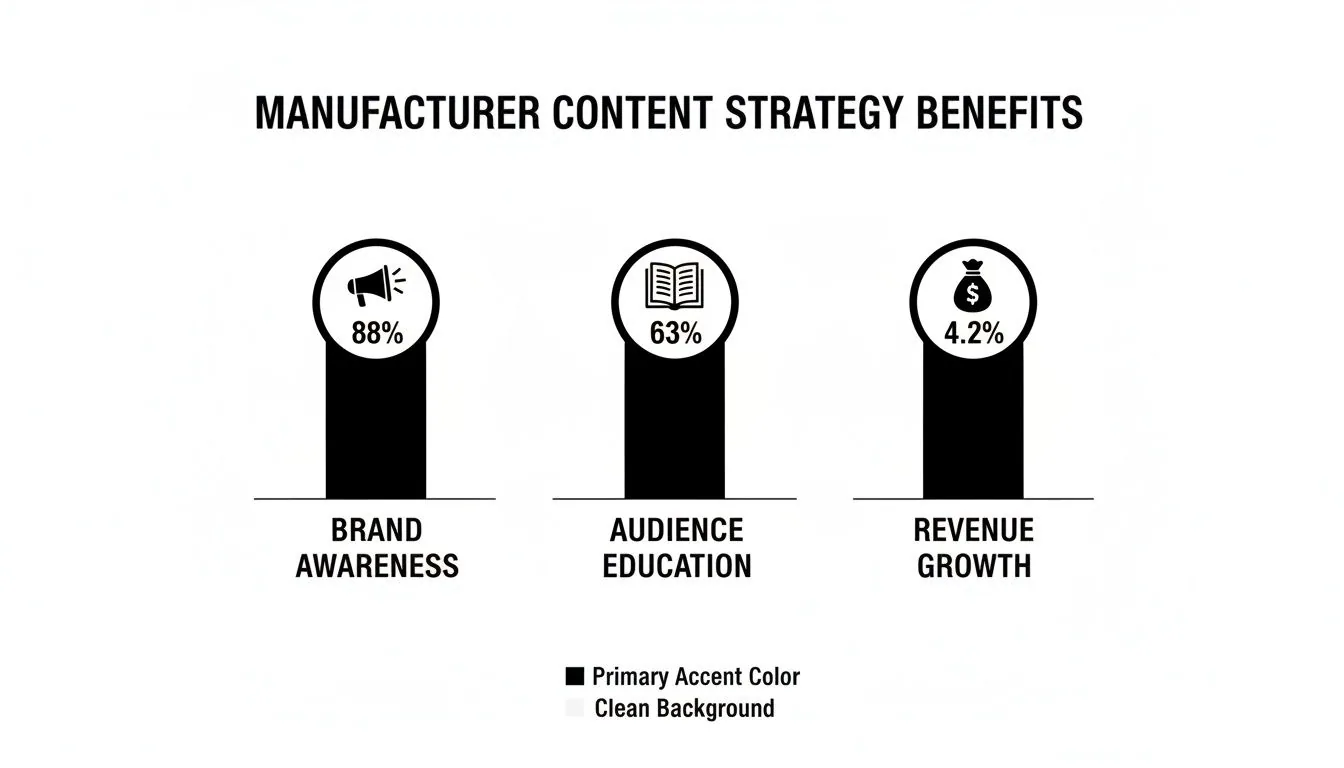
The U.S. manufacturing sector is a juggernaut, with around 623,000 businesses and a projected value of $2.1 trillion by 2025. In a market this competitive, you can't afford to ignore digital. A recent study showed a striking 88% of manufacturers now use website content for brand awareness, while 63% use it to educate their audience. This isn't just a trend; it's a fundamental shift in how leads are generated. To stay ahead, a strong digital presence is no longer optional.
Targeting High-Value Accounts with ABM and Paid Ads
While a solid inbound strategy builds a reliable asset over time, let's be honest—sometimes you need to go straight for your dream clients. This is where a sharp outbound strategy, combining Account-Based Marketing (ABM) with surgical paid ads, can slash sales cycles and help you land those bigger contracts.
Instead of casting a wide net and hoping for the best, ABM is all about focus. You're putting all your marketing and sales energy into a hand-picked list of high-value accounts. We're not just talking about a list of company names; this is a strategic roster of businesses that are a perfect fit for you and have the biggest revenue potential.
Building Your Target Account List
The entire ABM program hinges on the quality of your target account list. This is more than just pulling some company data. A great place to start is by looking at your best existing customers. What do they have in common? What specific industry niches are they in? What operational headaches did you solve for them?
Once you have that profile, you can hunt for similar companies. Tools like LinkedIn Sales Navigator are indispensable here. It lets you get incredibly granular with your search filters:
Industry: Go beyond broad categories. Target specific niches like "aerospace component manufacturing" or "pharmaceutical packaging."
Company Size: Zero in on businesses with the right headcount or revenue to afford your solution.
Geography: Pinpoint companies in the specific territories your sales team is focused on.
Keywords: Search for company profiles that mention specific technologies, equipment, or processes you specialize in.
The goal is to curate a manageable list—one where you can genuinely invest in personalized outreach. That intense focus is precisely what makes ABM so powerful for B2B manufacturers.
Launching Hyper-Specific Paid Ad Campaigns
With your target list in hand, paid advertising becomes your strategic air cover. Forget about broad, generic campaigns. Now you can run ads that speak directly to the unique challenges of these specific accounts. For this kind of B2B targeting, LinkedIn is king.
You can upload your account list directly into LinkedIn's ad platform and choose to only show ads to employees at those specific companies. Take it a step further by layering on job title filters—think "Plant Manager," "Director of Engineering," or "Procurement Specialist"—to make sure your message hits every member of the buying committee.
Your ad creative needs to match this level of precision. Instead of a general brand message, use copy and images that resonate with their world. For example, an ad aimed at automotive manufacturers could feature a case study on how you helped a competitor reduce assembly line downtime by 18%. That's the kind of personalized message that cuts through the noise. To really maximize your spend, it's worth digging into the finer points of using PPC for lead generation.
This infographic really drives home how manufacturers think about their content goals, with a huge emphasis on awareness and education.
You can see that while building brand awareness is a top priority, direct revenue growth often appears as a secondary goal. This highlights why a targeted strategy like ABM is so critical—it bridges the gap between those top-of-funnel activities and bottom-line results.
The True Cost of Manufacturing Leads
It's crucial to be realistic about the investment here. Before diving in, it helps to understand what you're up against and where your budget should go. Here's a quick comparison of the most common channels.
Lead Generation Channel Cost and Effectiveness Comparison for Manufacturers
Channel
Average CPL (Manufacturing)
Lead Quality
Best Use Case
Paid Search (PPC)
$150 - $400+
Medium to High
Capturing high-intent prospects actively searching for solutions. Great for bottom-of-funnel keywords.
SEO / Organic
$50 - $200
High
Building long-term authority and attracting highly relevant traffic. Best for sustained, compounding growth.
LinkedIn Ads (ABM)
$200 - $600+
Very High
Targeting specific job titles at pre-selected high-value companies. Ideal for strategic account penetration.
Content Syndication
$40 - $150
Low to Medium
Broad-based lead generation for top-of-funnel content like whitepapers. Requires heavy lead nurturing.
Trade Shows / Events
$500 - $1,500+
Varies (High Potential)
Building relationships and generating high-quality leads, but with a significant time and cost investment.
The numbers don't lie. Lead generation in manufacturing is expensive—among the highest of any industry. Recent 2025 data shows a blended average cost of $553 per lead, which breaks down to $691 for paid channels and $415 for organic.
This high cost reflects the reality of the business: long, complex sales cycles with multiple decision-makers. It puts manufacturing right behind notoriously pricey sectors like enterprise software.
The point of ABM and targeted paid ads isn't to find the cheapest leads. It's about achieving the highest return on investment. You're intentionally focusing your budget on accounts with the greatest potential to close high-value, long-term contracts that easily justify the upfront acquisition cost.
This approach absolutely requires a tight-knit partnership between marketing and sales. Marketing's job is to warm up the accounts with targeted ads and personalized content. At the same time, sales can use tools like Sales Navigator to identify the key contacts and start meaningful conversations based on the engagement data marketing is gathering. It’s a coordinated attack that turns lead generation from a numbers game into a strategic hunt for your best future customers.
Turning Your Website Into a Conversion Engine
Getting traffic to your website with SEO and paid ads is a great start, but traffic alone doesn't pay the bills. The real measure of your lead generation for manufacturers strategy is whether you can turn those clicks into actual, qualified inquiries.
This is where conversion rate optimization (CRO) comes into play. It’s the art and science of transforming your site from a static digital brochure into an active lead-generating machine. Every single element, from your headlines to your button colors, needs to work together to guide a potential buyer toward taking that next step.
For manufacturers, this means optimizing your product and landing pages for a very specific audience—one that's often highly technical and inherently skeptical. It all boils down to building trust, providing clarity, and removing every last bit of friction.
Anatomy of a High-Converting Product Page
Let's get real: your product pages are where engineers and procurement managers make mission-critical decisions. They aren't there to be wowed by flashy marketing copy; they need hard data, and they need it presented clearly and quickly. A product page that converts is one that speaks their language and gives them everything they need to move forward.
Think about who's landing on that page. An engineer needs to find technical specifications, compatibility info, and performance data—fast. A purchasing manager is looking for pricing, lead times, and evidence of your reliability. Your page has to serve both of them without missing a beat.
Here’s what your product pages absolutely must include:
A Crystal-Clear Value Proposition: Right at the top, tell them exactly what the product is and the specific problem it solves. Ditch the jargon and give them a direct benefit statement.
High-Quality Visuals: Show, don't just tell. Include multiple high-resolution images, videos of the product in action, and if possible, even 3D models or schematics.
Detailed Technical Specifications: Don't bury the specs in a PDF. Use clean tables or bulleted lists to lay out dimensions, materials, tolerances, and performance metrics. Make it scannable.
Downloadable Assets: Offering easy access to CAD files, spec sheets, and installation guides is a huge win. It's a powerful lead magnet and one of the clearest buying signals you can get.
Building Unshakeable Trust and Credibility
In B2B manufacturing, a buyer’s decision isn’t just about a product; it’s a career decision. They have to be absolutely sure they are choosing a reliable partner. That's why your website needs to be loaded with trust signals that demolish doubt and build rock-solid confidence.
These aren't just "nice-to-haves"—they're essential for getting past a buyer's initial hesitation.
Here's a statistic that should get your attention: more than 70% of B2B buyers fully map out their needs before they ever pick up the phone to talk to a sales rep. Your website is your opening argument, and it might be the only chance you get to prove you're a contender.
Sprinkling these signals across your site can make a massive difference in your conversion rates:
Certifications and Compliance: Are you ISO 9001 certified? Do you meet specific industry standards like AS9100 for aerospace? Get those badges front and center.
Client Logos: Showing the logos of well-known companies you work with is one of the fastest shortcuts to establishing credibility.
Case Studies and Testimonials: Feature short, impactful quotes from happy customers. Better yet, link them to detailed case studies that prove your value with real, hard numbers.
Guarantees and Warranties: Be upfront about your product warranties and satisfaction guarantees. This directly reduces the perceived risk for the buyer.
Crafting CTAs That Guide the Next Step
A generic "Contact Us" button just doesn't cut it anymore. Your call-to-action (CTA) has to align with where the visitor is in their buying journey. Someone on a product page might not be ready for a sales call, but they are almost certainly ready for the next logical step in their research.
This means your CTAs should be varied and specific to the user's intent. For instance:
For the Engineer: "Download CAD File" or "View Spec Sheet"
For the Procurement Manager: "Request a Formal Quote" or "Check Lead Times"
For the Early-Stage Researcher: "Download Our Buyer's Guide" or "Watch a Demo"
Ultimately, the goal is to create a completely frictionless user experience (UX). Your site has to be fast, mobile-friendly, and dead simple to navigate. An engineer on the plant floor trying to pull up specs on a tablet can't be pinching and zooming on a site designed for a desktop. Every dead end, every broken link, every slow-loading page is a potential lead lost forever. When you put real effort into CRO, you give all that hard-won traffic the best possible chance to actually become a customer.
Aligning Marketing and Sales for Better Leads
Let's talk about the single most expensive leak in a manufacturer's revenue pipeline: the handoff from marketing to sales. It's a classic story. Marketing generates a lead, tosses it over the fence, and sales either ignores it or calls it junk. This disconnect doesn't just waste marketing budget; it demoralizes the sales team and lets perfectly good deals die on the vine.
Fixing this isn't about scheduling more meetings. It’s about building a shared system—a common language for what a good lead looks like and a clear process for what happens next. When both teams are on the same page, you plug the leak and start building a real growth engine. Getting this right is a cornerstone of any effective lead generation for manufacturers strategy.
Defining Your Funnel Stages Together
Most of the friction between sales and marketing comes down to a simple language barrier. What marketing calls a "hot lead," sales might see as a "tire-kicker." The only way to fix this is to sit down and create a Service Level Agreement (SLA) that clearly defines the stages of your funnel. No ambiguity allowed.
The two most critical definitions you'll create are the Marketing Qualified Lead (MQL) and the Sales Qualified Lead (SQL).
Marketing Qualified Lead (MQL): This isn't just a random website visitor. An MQL is a lead that fits your basic company profile and has shown real interest by engaging with your content. Their actions signal they're actively researching a solution like yours.
Sales Qualified Lead (SQL): This is an MQL that sales has personally vetted and confirmed as a legitimate opportunity. They have the budget, authority, and a project timeline that makes them a real prospect worth pursuing.
The secret is that both teams must build these definitions together. Sales brings the street-level truth about what makes a prospect worth calling. Marketing brings the data on what online behaviors signal real intent. When everyone agrees, the blame game ends.
This collaboration is powerful. It means marketing starts laser-focusing its efforts on attracting the exact kind of leads the sales team is excited to talk to, which makes the whole process more efficient.
Building a Simple and Effective Lead Scoring System
Once you know what an MQL looks like, you need a way to spot them automatically. That’s where lead scoring comes in. It’s a straightforward system that assigns points to prospects based on who they are and what they do on your site. Once a lead hits a specific point threshold, they’re flagged as an MQL and automatically routed to sales. Simple.
For manufacturers, a solid lead scoring model should balance two key areas:
Firmographics (Who they are): How well do they match your Ideal Customer Profile? Think industry, company size, and job title.
Behaviors (What they do): How engaged are they? This tracks high-value actions like downloading a spec sheet or watching a demo.
Here’s a quick example of how you might set up your points:
Firmographic Criteria
Points
Behavioral Criteria
Points
Industry (e.g., Aerospace)
+20
Downloaded Technical Guide
+25
Job Title (e.g., Engineer)
+15
Visited Product Spec Page
+15
Company Size (100-500)
+10
Watched a Product Demo Video
+10
Industry (Other)
+5
Downloaded General eBook
+5
In this scenario, an engineer from an aerospace company who downloads a technical guide instantly earns 60 points. If your MQL threshold is set at 50, that lead is immediately sent to sales for follow-up. This system frees your sales reps to spend their valuable time on prospects who have clearly raised their hand, not on chasing cold leads.
Creating a Powerful Feedback Loop
The last piece of the alignment puzzle is a constant, structured feedback loop. This is what connects sales activity back to marketing strategy, making the entire process smarter over time. When sales gets a lead, they need to update its status in the CRM promptly.
This isn't just about accountability; it's about intelligence gathering.
If sales consistently rejects MQLs from a specific industry, marketing learns to tweak its targeting. If leads who watch a certain product demo have a sky-high close rate, marketing knows to put more budget behind promoting that video.
This feedback turns your marketing from a guessing game into a predictable revenue driver. Every campaign and piece of content gets refined based on real sales outcomes, ensuring your lead generation efforts are always dialed in on what actually works.
Answering Your Top Questions on Manufacturing Lead Gen
Jumping into modern marketing can feel like a big shift, especially when you're dealing with long sales cycles and highly technical buyers. Let's clear up some of the common questions and sticking points I see manufacturers run into when they're trying to build a reliable system for bringing in new business.
How Long Until We Actually See Results From SEO?
Let’s be honest: SEO isn't a magic wand you can wave for instant leads. It's a long-term play, and for most manufacturers, you’re looking at a 6 to 12 month runway before you see a real, noticeable impact on your organic traffic and lead numbers. Think of it as building a foundation—it takes time, but the result is solid and lasting.
That said, you can definitely score some early wins. I've seen clients start ranking in just 3 to 6 months by going after very specific, long-tail keywords. Instead of "CNC machining," think "high-tolerance CNC machining for medical devices." The timeline really hinges on where your website stands today, how crowded your niche is, and how consistently you're pushing out genuinely helpful technical content.
The real beauty of SEO? Unlike paid ads that vanish the moment you stop paying, the authority you build is cumulative. It becomes a valuable, lead-generating asset for your business that works for you around the clock.
What Numbers Should We Actually Be Watching?
It's way too easy to get bogged down in data. Forget the vanity metrics like raw website traffic or total lead volume. The numbers that really move the needle are the ones you can trace directly back to revenue and how efficiently your sales team is operating.
If you want a true health check on your marketing efforts, zero in on these KPIs:
Cost Per Lead (CPL): Simple but powerful. How much are you spending to get one new lead in the door?
Marketing Qualified Leads (MQLs): How many of those leads actually fit your ideal customer profile and have shown real interest?
Sales Qualified Leads (SQLs): Of those MQLs, which ones has your sales team agreed are legitimate, viable opportunities worth their time?
Lead-to-Customer Conversion Rate: What percentage of your leads actually sign on the dotted line?
Customer Lifetime Value (CLV): What’s the total long-term revenue you can expect from a single customer? This tells you how much you can afford to spend to acquire them.
And here’s a pro-tip: keep an eye on pipeline velocity. Measuring how fast a lead moves from initial contact to a closed deal is a fantastic way to gauge the real-world impact of your marketing.
Is Social Media a Waste of Time If Our Audience Isn’t There?
I hear this one a lot, and it's a common misunderstanding. Even if the engineers you sell to aren't endlessly scrolling social media, a platform like LinkedIn is absolutely essential. The trick is to stop thinking of it as a "social network" and start seeing it for what it is: a massive professional database and a critical research tool.
LinkedIn is the go-to place for identifying the exact decision-makers you need for Account-Based Marketing (ABM). It's where you can share deep-dive technical case studies and run ads targeted with surgical precision to people based on their job title, industry, or company size. Its power isn't in chasing likes, but in building credibility and enabling the kind of targeted outreach that closes high-value B2B deals.
Should We Put Our Best Content Behind a Form?
The best approach isn’t all or nothing. It's a strategic mix. You can—and should—do both to get the best of both worlds: lead generation and SEO visibility.
The trick is to gate your most valuable, in-depth assets. Think comprehensive whitepapers, ROI calculators, or the full recording of a technical webinar. These are your heavy hitters. Someone willing to exchange their contact info for this content is signaling a serious level of interest.
At the same time, you need to leave plenty of your content open and accessible. This is how you build trust and, just as importantly, rank on search engines. Things like blog posts, product spec sheets, and brief case study summaries should be free for all. A great play is to offer a valuable, ungated article that naturally tees up a more detailed, gated resource for those who want to go deeper.