What Is ROAS in Digital Marketing: A Guide to Profitable Advertising
AL
Andrea Larsen
When you're pouring money into digital ads, one question matters more than any other: is it working? In digital marketing, Return on Ad Spend (ROAS) is the metric that answers that question with brutal honesty. It measures how much revenue you get back for every single dollar you spend.
Think of it as the ultimate report card for your advertising. It cuts through vanity metrics and shows you the direct financial impact of your campaigns.
Feeling like you're flying blind with your campaigns? Get a free audit of your marketing or PPC strategy from our team. We'll shine a light on where your ad spend is going and show you how to get more out of it. Request your free audit today.
Decoding ROAS for Profitable Advertising
Let's make this simple. Imagine you run a lemonade stand and spend $10 on a flashy sign to pull in more customers. By the end of the day, people who saw that sign have bought $50 worth of lemonade.
Your ROAS is 5:1, or simply 5x. For every dollar you put into that sign, you got five dollars back. That's the core of what ROAS is in digital marketing.
It’s arguably the most critical metric for evaluating ad performance because it ties spend directly to revenue. While things like clicks, impressions, and click-through rates (CTR) are good to know, they don't tell you if you're actually making money. ROAS gives you the cold, hard financial truth.
To make it even clearer, here's a quick summary.
ROAS At a Glance
Concept
Description
What it is
A marketing metric that measures the amount of revenue earned for every dollar spent on advertising.
Why it's crucial
It directly links advertising efforts to financial results, revealing the true profitability of campaigns.
The formula
Total Campaign Revenue / Total Ad Cost
This simple calculation is the foundation for making smarter, more profitable advertising decisions.
Why Does ROAS Matter So Much?
Tracking ROAS is non-negotiable if you want to make data-driven decisions that actually grow your business. Without it, you're just throwing money at the wall and hoping something sticks.
Here’s why every serious advertiser lives and dies by this number:
Profitability Check: It’s the fastest way to know if a campaign is making you money or just burning through your budget.
Informed Budget Allocation: When you know which campaigns deliver the highest returns, you can confidently shift your ad spend to what’s working and cut what’s not.
Performance Benchmarking: ROAS lets you compare apples to apples, whether you're looking at different channels, ad creatives, or targeting strategies.
ROAS isn't just a number; it's a compass for your entire paid advertising strategy. It guides your budget, validates your creative choices, and ultimately determines whether your campaigns are a source of growth or a financial drain.
Ultimately, a firm grasp on ROAS helps you turn your marketing into a fine-tuned machine. You can stop wasting money on underperforming ads and double down on the winners, ensuring every dollar is invested with a clear purpose. It shifts advertising from a guessing game to a predictable engine for business growth.
How to Actually Calculate ROAS
Alright, let's get down to brass tacks. The beauty of ROAS is that you don't need a degree in finance to figure it out. It's a surprisingly simple formula that gives you a quick, clean read on whether your ads are actually making money.
The calculation itself is incredibly straightforward:
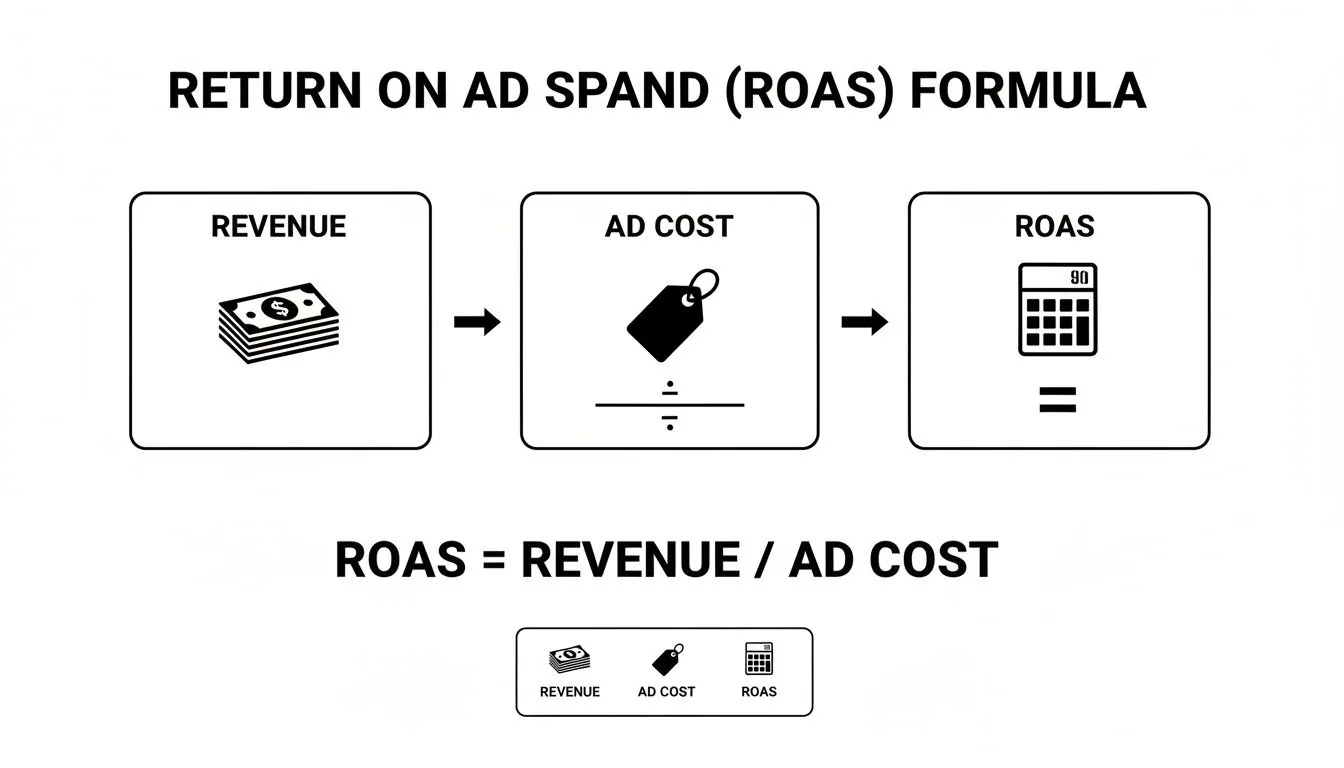
ROAS = Total Revenue from Ads / Total Ad Cost
That’s it. The number you get back is a ratio. So, a ROAS of 4 means you're making $4 for every $1 you spend on ads. A ROAS of 8 means you're bringing in $8 for every $1 invested. Simple, right?
Let’s See the ROAS Formula in Action
Theory is one thing, but let's run the numbers for two very different businesses to see how this plays out in the real world.
Example 1: E-Commerce Shoe Store
Imagine you run an online shoe brand called "SoleMates." You decide to launch a Google Shopping campaign for a new line of running shoes.
Total Ad Cost: You spend $2,000 on Google Ads for the month.
Total Revenue from Ads: That campaign drives $10,000 in direct sales.
Now, we just plug those numbers into our formula:
ROAS = $10,000 (Revenue) / $2,000 (Ad Cost)
Your ROAS is 5. You can also think of this as a 5:1 ratio. For every single dollar you gave Google, SoleMates got five dollars back. That’s a clear win—a profitable campaign worth scaling.
Example 2: B2B Software Company
This gets a little more interesting. Let's say a B2B SaaS company is running LinkedIn Ads to get qualified leads for its project management tool. Here, the immediate result isn't a sale, but a lead.
Total Ad Cost: They spend $5,000 on their LinkedIn campaign.
Leads Generated: The ads bring in 50 qualified leads.
Lead-to-Customer Rate: The sales team knows that, on average, 1 in 5 leads (20%) signs up.
Customer Lifetime Value (LTV): Each new customer is worth $3,000 to the business.
First, we need to figure out the actual revenue generated.
Total Revenue: 10 customers × $3,000 LTV = $30,000
Now we can calculate the ROAS:
ROAS = $30,000 (Revenue) / $5,000 (Ad Cost)
The ROAS comes out to 6, or 6:1. Even with a more complex sales funnel, the campaign is a massive success, turning every dollar spent into six.
The Hidden Costs That Can Sink Your ROAS
Here’s where a lot of marketers get it wrong. They only look at the media spend—the money paid directly to Google, Meta, or LinkedIn. But a true ROAS calculation has to include all the other costs that go into making those ads run.
Your "Total Ad Cost" isn't just the ad spend. It should also include:
Agency or Freelancer Fees: The retainers or project fees you pay for management.
Software & Tools: Any costs for analytics, design, or automation platforms.
Creative Production: The budget for videographers, graphic designers, or copywriters.
In-House Team Salaries: A portion of your marketing team's salaries dedicated to the campaigns.
Forgetting these costs will artificially inflate your ROAS and give you a dangerously misleading sense of success. By including every expense, you get an honest look at your campaign’s health. This is crucial for making smart decisions and hitting that widely accepted benchmark of a 4:1 ROAS, which is often the sweet spot for sustainable profitability.
What Is a Good ROAS? Realistic Industry Benchmarks
So, what’s a "good" ROAS? Asking that is a bit like asking how long a piece of string is—the answer is always, "it depends."
A 3:1 ROAS might be a massive win for a business with healthy profit margins, but it could spell disaster for another running on fumes. There’s simply no magic number that works for everyone. The only "good" ROAS is the one that's profitable for your business, factoring in your unique margins, industry, and overall financial health.
Before you can even think about setting a target, you need to know your floor. This is where your breakeven point comes in.
Finding Your Breakeven ROAS
Your breakeven ROAS is the absolute minimum you need to make back just to cover your ad spend and the cost of your goods. Hit this number, and you haven't made or lost a dime. Fall below it, and you're officially paying to give your products away.
Calculating it is surprisingly simple.
Breakeven ROAS = 1 / Your Profit Margin
Let's say your business operates on a 40% profit margin. The math would be 1 / 0.40, which gives you 2.5. This means you need to generate $2.50 in revenue for every $1 you spend on ads just to stay afloat. A 3:1 ROAS in this scenario is profitable, while a 2:1 is a clear loss.
This simple formula is the foundation of every paid ad strategy.
Knowing your breakeven point turns ROAS from an abstract metric into a powerful lever for profitability.
Setting Realistic Benchmarks Across Platforms
Once you know your breakeven number, you can start looking at industry averages to set ambitious but achievable goals. Keep in mind that performance can swing wildly from one channel to another based on things like user intent, ad format, and audience targeting.
For instance, Meta (Facebook) Ads often boast a strong average ROAS around 4:1 (400%), which means $4 in revenue for every $1 spent. Google Ads hover closer to a 2:1 (200%) average overall, but their Shopping campaigns are a different story. For e-commerce, it’s not uncommon to see pros targeting 4:1 or higher, thanks to the high-intent nature of product searches.
To give you a clearer picture, here’s a breakdown of what you can generally expect.
Average ROAS Benchmarks by Platform and Channel
A comparative look at typical ROAS figures across popular digital marketing channels, helping businesses set realistic expectations.
Platform/Channel
Average ROAS (Return per $1 Spent)
Google Search Ads
2:1 (or 200%)
Google Shopping Ads
4:1 (or 400%) for e-commerce
Facebook Ads (Meta)
4:1 (or 400%)
Instagram Ads (Meta)
3:1 (or 300%)
Amazon Ads
3:1 (or 300%)
Bing Ads
2.5:1 (or 250%)
These numbers are just a starting point, not gospel. A startup focused on aggressive growth might be perfectly happy with a lower initial ROAS if they know they're acquiring customers with a high lifetime value (LTV). On the other hand, a business prioritizing immediate cash flow will need to hit a higher ROAS right out of the gate.
Ultimately, a "good" ROAS isn't about hitting an industry average. It's about finding the number that fuels your business model and gets you closer to your specific goals.
Understanding ROAS vs. ROI vs. LTV
It’s easy to get lost in an alphabet soup of marketing metrics. While ROAS gives you a sharp, tactical view of your ad performance, it doesn't paint the whole picture by itself. To make genuinely smart business decisions, you need to see how it fits with two other powerhouses: Return on Investment (ROI) and Customer Lifetime Value (LTV).
The best way to think about these three is like different camera lenses. Each one gives you a unique perspective on your business's health and performance.
ROAS: The Microscopic View
As we've covered, ROAS (Return on Ad Spend) is hyper-focused. It zooms right in on a specific campaign or ad channel to answer one simple question: "For every dollar we put into these ads, how many dollars in revenue did we get back?"
Scope: Very narrow, often at the campaign or even ad group level.
Purpose: To measure the direct revenue efficiency of your advertising efforts.
Formula: Revenue from Ads / Cost of Ads.
ROAS is the perfect metric for a PPC manager fine-tuning bids, testing ad creative, and deciding which campaigns to scale up or shut down. It's all about immediate, tactical effectiveness.
ROI: The Panoramic View
ROI (Return on Investment) pulls the camera back for a much wider shot. It assesses the overall profitability of an entire marketing initiative by factoring in all the costs, not just the ad spend. This means including things like salaries, software subscriptions, overhead, and the cost of the goods you sold.
The question ROI answers is a big one: "After we account for absolutely every expense, did this effort actually make us a profit?" If you want to dive deeper, we have a complete guide on how to calculate marketing ROI.
A campaign can have a great ROAS but still lose money. Imagine you hit a 3:1 ROAS, which sounds decent. But if your profit margin is only 25%, you're actually in the red once you factor in the cost of your product and operations.
This is a critical distinction. One analysis of 52 clients found that a campaign showing a 2.13 ROAS only produced a tiny 6.7% ROI after all costs were tallied. This is a perfect example of why looking at ROAS alone can be dangerously misleading.
LTV: The Long-Term Cinematic View
Finally, LTV (Customer Lifetime Value) gives you the epic, long-term cinematic view. It’s a predictive metric that estimates the total net profit a single customer will bring to your business over the entire course of their relationship with you.
LTV answers the ultimate question: "How valuable are the customers we're bringing in?" This shifts the focus from a single sale to the long-term health and sustainability of your business. A campaign might have a so-so ROAS but be incredibly successful if it attracts loyal customers who buy from you again and again for years.
Think about these two campaigns:
Campaign A: Hits a massive 10:1 ROAS by selling a low-cost, trendy item to one-time buyers.
Campaign B: Only manages a 3:1 ROAS but acquires customers who sign up for a valuable yearly subscription.
On paper, Campaign A looks like the clear winner. But Campaign B is the one building a predictable, sustainable, and far more valuable business. Understanding LTV helps you see the true impact of your advertising far beyond that first transaction.
Actionable Strategies to Improve Your ROAS
Knowing your ROAS is one thing, but actually improving it is where the real work begins. It’s all about turning that data into dollars. To do this well, you need to attack the problem from two sides: what happens before the click (your ad campaigns) and what happens after the click (your landing page and checkout).
Think of this as our battle-tested playbook for making every single ad dollar pull more weight. Let's dig into the practical steps you can start taking right now.
Fine-Tune Your Ad Campaigns
The bedrock of a killer ROAS is an ad campaign that’s ruthlessly efficient. You have to get the right message in front of the right eyeballs. Wasting your budget on clicks from the wrong people is the fastest way to kill your returns before they even have a chance.
First, get surgical with your audience targeting. Stop casting a wide, expensive net. Instead, build out detailed customer personas and use them to slice your audience into hyper-specific segments. You can layer demographic data with interests, online behaviors, and even purchase intent signals to make sure your ads are only hitting the screens of people who are genuinely likely to convert.
Next up is relentless A/B testing of your creative. This isn't a "set it and forget it" task; it’s an ongoing process of tweaking and refining. You should be testing everything:
Headlines: Try posing a question versus stating a clear benefit. See which one grabs more attention.
Ad Copy: Does a quick, punchy sentence outperform a more detailed paragraph? You won't know until you test.
Visuals: Pit your best static image against a short video clip or an animated GIF.
Calls-to-Action (CTAs): Does "Shop Now" work better than "Learn More"? The answer might surprise you.
Even tiny lifts in click-through rates from these simple tests can cascade into a much healthier ROAS.
Your negative keyword list is one of the most powerful—and most overlooked—tools for boosting ROAS. Make it a habit to dig through your search term reports. Find and block all the irrelevant queries that are accidentally triggering your ads. It's like plugging a leak in your budget.
Finally, take a hard look at your channel strategy. Not all platforms are created equal. Dive into your analytics and compare performance across Google, Meta, LinkedIn, or wherever you're spending money. Find your winners and double down on them. And don't be afraid to cut the cord on platforms that just aren't pulling their weight.
Optimize the Post-Click Experience
Getting the click is just half the battle. If your landing page drops the ball, all that hard work (and money) goes to waste. The journey after the click has to be smooth, persuasive, and completely free of friction.
Your landing page is your digital handshake, and that first impression matters. Make sure your page loads lightning-fast—we're talking under three seconds. Slow load times are a notorious conversion killer. The page's main headline and hero image should also be a perfect match for the ad that brought them there, immediately letting visitors know they're in the right place.
To really get that page converting, you need to include:
Clear and Compelling Copy: Talk about the customer's problems and how you solve them, not just your product's features.
Strong Social Proof: Show them they're not the first. Use customer testimonials, logos of well-known clients, or snippets from case studies.
A Single, Obvious CTA: Don't give them a paradox of choice. Guide them clearly to the one thing you want them to do next.
This focused approach is a huge part of any successful campaign. For more hands-on advice, check out our guide on how you can improve PPC performance by fine-tuning every step of your funnel.
If you’re in e-commerce, a frictionless checkout is non-negotiable. Cart abandonment is a massive ROAS killer, and it’s usually caused by things like surprise shipping costs, clunky forms, or not enough payment options. Cut your checkout down to the bare minimum number of steps, be upfront about all costs, and offer modern payment methods like PayPal or Apple Pay.
While we're talking about paid channels, it’s important to remember how efficient other channels can be. Email marketing, for instance, sets an incredibly high bar. Studies consistently show it brings in an average of $42 for every $1 spent—a mind-boggling 4,200% return. This highlights why an integrated strategy is so powerful. By combining paid ads with a solid email follow-up sequence, you can nurture those hard-won leads and dramatically increase their lifetime value, which in turn juices your overall returns.
Common Pitfalls in Measuring ROAS
Calculating your Return on Ad Spend seems simple enough on the surface, but that basic formula can hide some seriously complex problems. It's surprisingly common for businesses to track a ROAS that looks fantastic in a spreadsheet but is dangerously misleading in the real world.
These measurement mistakes usually boil down to a few critical, yet all-too-common, pitfalls that can completely throw off your budget decisions.
The Last-Click Attribution Trap
The most frequent mistake we see is relying on a flawed attribution model. Most ad platforms, right out of the box, use a "last-click" model. This means they give 100% of the credit for a sale to the very last ad a customer clicked before buying.
Think about that for a second. This model completely ignores all the other valuable touchpoints that got them there—the first social media ad that made them aware of you, the video they watched mid-way through their research, the retargeting ad that sealed the deal. It's like giving all the credit for a touchdown to the player who carried the ball over the goal line, ignoring the rest of the team that made it possible.
When you only value that final click, you start making bad calls. You'll likely cut funding for crucial top-of-funnel campaigns because they don't look like they're "converting," even though they're the ones filling your pipeline in the first place. Getting a more sophisticated view is essential for how to measure marketing performance accurately and understanding what's really driving sales.
Bridging the Gaps: Cross-Device and Offline Conversions
Another massive headache is cross-device tracking. A customer’s journey is rarely linear. They might see your ad on their phone during their morning commute, research your product on their work laptop later, and finally pull the trigger and buy from their home tablet that evening.
If your analytics setup can't stitch those actions together into a single user story, it looks like three different people showed a little interest and then vanished. Your data gets fragmented, your ROAS gets distorted, and you can't see the full picture.
The problem gets even worse for businesses that close deals offline.
If your ad drives a phone call that leads to a sale, or brings a customer into your store, but that revenue isn't fed back from your CRM to your ad platform, it’s like the conversion never happened. The campaign looks like a total failure, even if it's bringing in your best customers.
Fixing this means connecting your systems. Integrating your CRM with platforms like Google Analytics is key to creating a unified view of the customer journey, ensuring every dollar of ad-driven revenue gets counted.
The Real Cost of Flying Blind
Getting measurement wrong isn't just a technicality; it has huge financial consequences. Some estimates suggest that as much as 60% of ad spend is wasted on campaigns that just don't work. That’s a staggering number, and it underscores why getting your tracking right is so important.
When your measurement is off, you can’t spot that waste. You end up pouring good money after bad, doubling down on strategies that only look like they're working.
Ultimately, getting past these pitfalls means moving away from surface-level metrics. You need a deeper, more connected understanding of performance. By adopting smarter attribution models and integrating your data sources, you can finally get a true, reliable picture of your ROAS.
Frequently Asked Questions About ROAS
Even after you've got the basics down, you'll inevitably run into some specific questions when you start using ROAS to make real-world decisions. Here are some of the most common ones we hear from fellow marketers.
Can I Calculate ROAS for SEO or Content Marketing?
The short answer is yes, but it’s a bit different. ROAS is really built for the direct, dollar-in-dollar-out world of paid ads. When you try to apply the same logic to SEO or content marketing, it gets trickier.
To do it, you'd have to add up all your investment costs—think salaries, software subscriptions, and freelance writer fees. Then comes the hard part: accurately tracing revenue all the way back to your organic efforts. It's often called 'Return on Marketing Investment' (ROMI) at this point because it's so much broader than just ad spend. You'll need some serious analytics and a solid attribution model to pull it off.
How Long Should I Wait Before Measuring ROAS?
This completely depends on your sales cycle. There's no one-size-fits-all answer.
Short Sales Cycles (1-3 days): If you’re in e-commerce, you can usually get a decent read on ROAS within a week. Customers see an ad, click, and buy pretty quickly.
Long Sales Cycles (weeks or months): For B2B companies or anyone selling high-ticket items, you need to be patient. Measuring ROAS after just a week would be a huge mistake. Give it at least 30 or 60 days to let leads actually work their way through the funnel and become paying customers.
If you measure too soon with a long sales cycle, your ROAS will look terrible, and you might kill a perfectly good campaign before it has a chance to prove itself.
What Are the Best Tools for Tracking ROAS?
You'll need a few tools working together to get an accurate picture. The bare minimum is using the analytics built into the ad platforms themselves, like Google Ads and Meta Ads, and connecting them to Google Analytics to see what happens after the click.
But for the most accurate ROAS, you need to connect your ad platforms to your CRM. By integrating with something like Salesforce or HubSpot, you can follow a customer from the very first ad click all the way to a closed deal. This “closed-loop” reporting gives you the real revenue number, not just an estimate.