So, what exactly are white label PPC services?
Imagine you're a fantastic local café known for great coffee and service, but you don't have a professional baker on staff. Instead of building a full-scale bakery in your back room, you partner with a high-end wholesale baker who creates amazing, custom pastries for you. You put these pastries in your display case, under your café's brand, and sell them as your own. Your customers are happy, you make a profit, and the baker gets to do what they do best.
That's white label PPC in a nutshell. An expert pay-per-click agency does all the heavy lifting—the campaign creation, management, and optimization—and delivers it to you, ready to be presented to your clients under your brand name.
The Agency Growth Engine You Never See
This partnership lets marketing agencies, consultants, and even busy in-house teams instantly bolt on a sophisticated PPC offering. You get to skip the immense cost and time suck of building a specialized department from the ground up. No hiring, no training, no expensive software subscriptions. You just plug into a ready-made team of experts.
A good white label partner gives you immediate access to seasoned pros who are deep in the weeds of campaign management every single day. They take care of the complex, time-consuming work:
Keyword Research: Uncovering the high-intent search terms that actually lead to conversions.
Ad Creation: Writing ad copy and designing creative that grabs attention and gets clicks.
Bid Management: Constantly fine-tuning bids to squeeze the most value out of every dollar of ad spend.
Performance Reporting: Turning raw data into clean, branded reports you can confidently share with your clients.
To your client, it looks like you're doing it all. You own the relationship and steer the strategy. Your partner is your silent, invisible execution team in the background.
Why This Model Is Exploding In Popularity
This isn't just a niche strategy; it's becoming a mainstream growth hack. The global white label market, which includes services like white label PPC, is on track to hit a massive $99.19 billion by 2026.
The reason for this surge is simple. Around 73% of marketing agencies already use white label solutions to scale their services without ballooning their payroll.
It’s a smart response to what clients are demanding: full-service, integrated solutions. This model lets you provide that without getting distracted from your agency's core strengths.
A true white label partnership empowers you to say "yes" to more opportunities. It transforms a potential operational headache into a scalable and highly profitable revenue stream, allowing you to focus on client strategy and business growth.
White Label PPC At a Glance: Key Roles and Responsibilities
To make this work, everyone needs to know their role. A clear division of labor is what makes the partnership seamless. Your agency handles the client-facing strategy, while your partner manages the technical execution behind the scenes. This table breaks down a typical arrangement:
Task
Your Agency's Role (The Brand)
White Label Partner's Role (The Engine)
Client Communication
Primary point of contact, manages all meetings and strategic discussions.
Provides support and data to the agency; typically has no direct client contact.
Strategy & Goal Setting
Defines high-level business goals, KPIs, and budget with the client.
Translates business goals into technical PPC strategy and campaign structure.
Sales & Onboarding
Sells the PPC service, sets client expectations, and handles contracts.
Provides sales support, audits, and proposals for the agency to present.
Campaign Management
Reviews performance and provides strategic feedback.
Manages all day-to-day tasks: keyword research, bidding, ad copy, and optimization.
Reporting & Analysis
Presents branded reports to the client, explaining performance and next steps.
Creates detailed performance reports and provides insights for the agency.
Understanding this split is key to a successful partnership. You bring in the business and manage the big picture, while they make sure the engine is running perfectly. For a deeper dive into the specific tasks being handled by your partner, check out our guide on what's involved in PPC management.
The Real Benefits of Outsourcing PPC Management
Knowing what white-label PPC is is a good first step, but the real magic is in understanding why so many agencies are turning to it. This isn't just about convenience; it's a core growth strategy built on three powerful pillars: financial sense, operational muscle, and strategic focus.
Think of it like this: instead of trying to build a high-performance engine from scratch in your garage, you're plugging a professionally engineered, race-ready motor directly into your agency. You get all the power and speed right away, without the years of costly R&D.
Financial Efficiency Unlocked
The first thing you’ll notice is the impact on your bottom line. Building a capable in-house PPC team is a massive financial undertaking, and it's about a lot more than just one salary.
Let's break down the real costs you get to sidestep entirely:
Senior-Level Salaries: A seasoned PPC manager can easily command $70,000 to $100,000 a year, and that's before you factor in benefits, taxes, and other overhead.
Expensive Software Stacks: The enterprise-grade tools needed for serious keyword research, competitor tracking, and bid management can run you thousands of dollars every single month.
Continuous Training: The PPC world moves fast. You'd need a dedicated budget just for certifications and training to keep your team from falling behind.
A white label PPC partnership flips this script. It turns those hefty, fixed capital expenses into a predictable, variable operating cost. You pay for what you need, when you need it, making your entire financial model more flexible and ready for scale.
Gaining Instant Operational Excellence
Money aside, outsourcing gives you immediate access to a deep reservoir of specialized talent. A dedicated white-label provider lives and breathes pay-per-click. Their teams are in the trenches every day, managing dozens—sometimes hundreds—of campaigns across countless industries.
That kind of hands-on experience is almost impossible to replicate with a small in-house team. This operational firepower translates directly into better, faster results for your clients. Your partner's proven processes mean quicker campaign launches, smarter optimizations, and the ability to solve tricky problems without missing a beat. You get to skip the painful learning curve and start delivering expert-level work from day one.
By outsourcing the tactical execution, you are essentially acquiring years of collective experience and battle-tested systems overnight. This allows your agency to compete at a higher level, delivering campaign performance that builds client trust and drives long-term retention.
The Ultimate Strategic Advantage: Focus
This might be the most important benefit of all. Every hour your team spends wrestling with keyword match types or getting lost in pivot tables is an hour they aren't spending on high-value, client-facing work. Offloading the technical minutiae frees up your core people to focus on what truly grows your agency:
Building Stronger Client Relationships: More time for strategic check-ins, digging into your clients' business goals, and becoming a true marketing partner.
Crafting High-Level Strategy: Stepping back from campaign tactics to build integrated marketing plans that deliver real business impact.
Closing New Business: Pouring more energy into your sales pipeline, prospecting, and growing your client roster.
This simple shift changes PPC from a potential resource black hole into a profitable, scalable service. It's no surprise the market for white label PPC services is projected to grow at an 18% annual rate. More agencies are realizing this model lets them run world-class campaigns under their own brand, strengthening client relationships while freeing them up to focus on strategic growth.
How to Compare Engagement and Pricing Models
Picking the right white-label PPC partner goes beyond their campaign skills—it’s a major financial decision. The pricing model you agree on will directly shape your agency's profit margins, cash flow, and even how you scale your own business. Getting this right from the start is crucial for building a partnership that actually works for your bottom line.
Think of it like choosing a cell phone plan. Are you looking for the predictable cost of a flat monthly rate, the flexibility of pay-as-you-go, or something else entirely? Each has its place, and the best fit depends on your specific needs and financial strategy. The world of PPC engagement models works the same way.
Flat-Rate Retainer: The Predictability Champion
The most common and straightforward approach you'll find is the flat-rate retainer. With this model, your agency pays the white-label provider a fixed fee every month to manage a client’s account. These fees are usually tiered based on the client's monthly ad spend. For instance, a provider might charge a $1,000 monthly fee for any account spending up to $10,000.
This model is a favorite for agencies that need predictability. You know your exact cost of goods sold (COGS) every single month, which makes calculating your margins and pricing your services a breeze. It takes the guesswork out of the equation and protects your profitability, even if a client's ad spend wiggles a bit.
Percentage of Ad Spend: The Scalable Standard
Another popular option is the percentage of ad spend model. Here, the management fee is a direct cut of the client's total ad budget, typically landing somewhere between 10% and 20%. So, if a client spends $20,000 in a month and your deal is 15%, your cost for that management is $3,000.
This structure perfectly aligns the provider's pay with the amount of work required. As a client's budget grows, so does the management fee—and that’s fair, because bigger budgets mean more complexity and management. It’s an ideal fit for clients focused on growth, as it lets your costs and revenues scale up together. This model is a key piece of the puzzle when figuring out how much PPC costs for your end clients.
Performance-Based Models: The High-Risk, High-Reward Plays
Performance-based models link the provider's fee directly to specific results. This can be structured a couple of different ways, and each comes with its own set of potential wins and pitfalls.
Pay-Per-Lead (PPL): You pay a set price for every qualified lead they generate. This can sound great because you’re only paying for tangible results, but it can get messy. If your client's sales team struggles to close those leads, arguments over lead quality are almost inevitable.
Revenue Share: The provider gets a percentage of the actual revenue generated from their PPC campaigns. This is a true partnership model where everyone is pulling in the same direction: driving sales. It works best with e-commerce clients where you have rock-solid conversion tracking and healthy profit margins.
While performance models can look tempting, they require a ton of trust and absolutely flawless tracking. They bring a lot more variables into the mix, making them better for well-established partnerships, not brand-new ones.
Comparing Your Options Side-by-Side
To pick the right model, you have to weigh the pros and cons against your agency’s business goals, the types of clients you serve, and your appetite for risk. A simple side-by-side comparison can make it much clearer which financial setup will support your growth best.
White Label PPC Pricing Models Compared
Model
Best For
Pros
Cons
Flat-Rate Retainer
Agencies prioritizing budget predictability and consistent margins.
Simple to calculate profitability; costs are fixed and easy to explain.
May not scale fairly with very large or very small client budgets.
Percentage of Ad Spend
Agencies with growth-oriented clients whose budgets will increase over time.
Fees scale with the workload; provider is incentivized to manage growth.
Can lead to unpredictable costs month-to-month if ad spend fluctuates.
Pay-Per-Lead (PPL)
Lead generation campaigns where lead quality can be objectively verified.
You only pay for tangible results, reducing upfront financial risk.
High potential for disputes over lead quality; requires robust tracking.
Revenue Share
E-commerce or direct-sale businesses with sophisticated tracking.
The ultimate alignment of interests; partner is rewarded for driving sales.
Difficult to track accurately; gives the partner a stake in your client's revenue.
Ultimately, there's no single "best" model—only the one that's best for your agency. A newer agency might prefer the safety of a flat retainer, while a more established one with high-growth clients might find the percentage of ad spend model more lucrative in the long run.
Finding and Vetting the Right PPC Partner
Picking a white-label PPC partner is one of the biggest calls you'll make for your agency. Get it right, and you’ve got a seamless extension of your team that fuels growth and keeps clients happy. But get it wrong, and you’re looking at eroded client trust, a damaged reputation, and a whole lot of operational chaos.
This isn't a decision you can base on a slick sales deck. You need to get your hands dirty and dig into their actual process, their expertise, and their commitment to being an open book. Think of it like hiring a new Director of Paid Media—you wouldn’t just take their word for it, you’d grill them on their experience and check every last reference.
Starting Your Search for the Right Fit
Before you even book a single demo, you need a crystal-clear picture of what an ideal partner looks like for your agency. Not all white-label providers are cut from the same cloth. Some are fantastic with small local businesses, while others are geared up for complex, enterprise-level campaigns with eye-watering budgets.
So, the first step is an internal one: document your own needs and what your typical clients require.
Think through these key areas:
Industry Specialization: Do you work mostly with e-commerce brands, B2B SaaS companies, or local service businesses? You want a partner who already speaks your clients' language.
Platform Expertise: Are your clients all about Google Ads and Meta, or do they need deep expertise in LinkedIn Ads or niche platforms like Amazon PPC? Make sure the provider has proven skills where it counts.
Budgetary Scope: Are we talking $5,000 a month or $500,000? A partner’s entire workflow and pricing model needs to match the scale you’re operating at.
As you look around, it can be helpful to check out resources like a list of the top Amazon PPC management agencies. Seeing how the best in a specific niche position themselves gives you a good benchmark for what real expertise looks like.
Your Vetting Checklist: Non-Negotiable Questions to Ask
Okay, you've got a shortlist. Now it's time to go deep. Your mission is to understand exactly how they operate behind the curtain. Treat this like a fact-finding mission, not just a friendly chat.
Here are the questions you absolutely have to ask:
Who is actually managing my client's account? You need to know if you're getting a dedicated account manager or if your client will be passed around a pod. Ask about the specific experience level of the person who will be in the driver's seat.
Can you show me a sample of your client reporting? This is a deal-breaker. A great partner delivers clean, branded reports that offer real insights, not just a spreadsheet full of clicks and impressions. You want to see analysis, not just data.
What’s your process when a campaign is underperforming? Run from anyone who promises the moon. You’re looking for a partner with a clear, data-backed plan for diagnosing problems, communicating bad news, and turning things around.
How do you handle transparency and data ownership? You and your client should always have full, admin-level access to the ad accounts. If a provider pushes back on this, it’s a giant red flag. What are they trying to hide?
Your white-label PPC partner is the silent engine powering your paid media services. Their work is a direct reflection of your brand. Never, ever compromise on transparency, clear communication, or proven expertise.
Red Flags That Scream "Run Away"
Asking the right questions is half the battle. The other half is knowing when to walk away. If you spot any of these warning signs, it’s time to hit the brakes.
Unrealistic Guarantees: Nobody can guarantee a #1 ranking or a specific ROAS. Anyone who does is either inexperienced or dishonest.
"Black Box" Operations: If they’re vague about strategy or won't give you direct account access, they aren't a partner. They’re a liability.
No Real Case Studies: A legitimate provider will have a library of success stories and be ready to share verifiable results from clients similar to yours.
Poor Communication: If they’re slow, sloppy, or unclear during the sales process, just imagine what it’ll be like when there’s a real fire to put out.
In the end, choosing the right provider is all about doing your homework. Take your time, ask the tough questions, and trust your gut. A great partnership feels right from the very first conversation—collaborative, honest, and completely transparent.
Building a Seamless Onboarding and Reporting System
A partnership with a white-label PPC provider is only as good as the systems that support it. Without clear, structured processes from day one, you're setting yourself up for miscommunication and misaligned expectations that can bleed over into your client relationships. A great partnership is built on seamless integration, and that starts with a rock-solid onboarding plan.
The first steps are absolutely crucial. This isn't just about handing over account access; it's a dedicated knowledge transfer. A quality partner will kick things off with a detailed discovery call with your team to soak up every detail about the client’s business, their goals, and who they’re trying to reach. Right after that, you should set up shared communication channels—like a dedicated Slack channel or a project management board—to keep collaboration transparent and in real-time.
A huge part of a smooth white-label partnership is making sure the transition feels effortless for your clients, which all comes down to solid client onboarding best practices. This early stage really sets the tone for everything that follows.
Defining What Great Reporting Looks Like
Once the campaigns are up and running, the focus shifts to reporting. Frankly, this is where a lot of partnerships fall apart. Vague, data-dump reports filled with vanity metrics like impressions and clicks are just noise. Real value comes from dashboards that connect PPC performance directly to your client’s actual business goals.
Great reporting tells a story; it doesn't just spit out numbers. It should clearly separate the metrics that matter—the Key Performance Indicators (KPIs)—from all the distracting data points.
Meaningful KPIs: Think metrics like Cost Per Acquisition (CPA), Return on Ad Spend (ROAS), and Conversion Rate. These directly measure the financial impact of the campaigns.
Vanity Metrics: This is where you find things like Clicks and Impressions. They can be useful for diagnosing campaign issues, but they don't tell your client if they're actually making money.
Good reporting is a massive performance driver. Expert-led PPC management has been shown to boost campaign efficiency by 25–35%, and that’s largely thanks to better analysis and optimization. One brand, for example, dropped its customer acquisition cost from $120 to $86 in just 90 days after bringing in a white-label team. This was fueled by a 28% jump in click-through rates.
The goal of a report is to provide clarity, not complexity. Your white-label partner should deliver branded, easy-to-digest dashboards that let you walk into client meetings with confidence, armed with actionable insights and clear next steps.
Establishing a Rock-Solid Service Level Agreement
Think of the Service Level Agreement (SLA) as the official rulebook for your partnership. It’s what turns a casual handshake deal into a professional, accountable alliance by putting everyone's expectations down on paper.
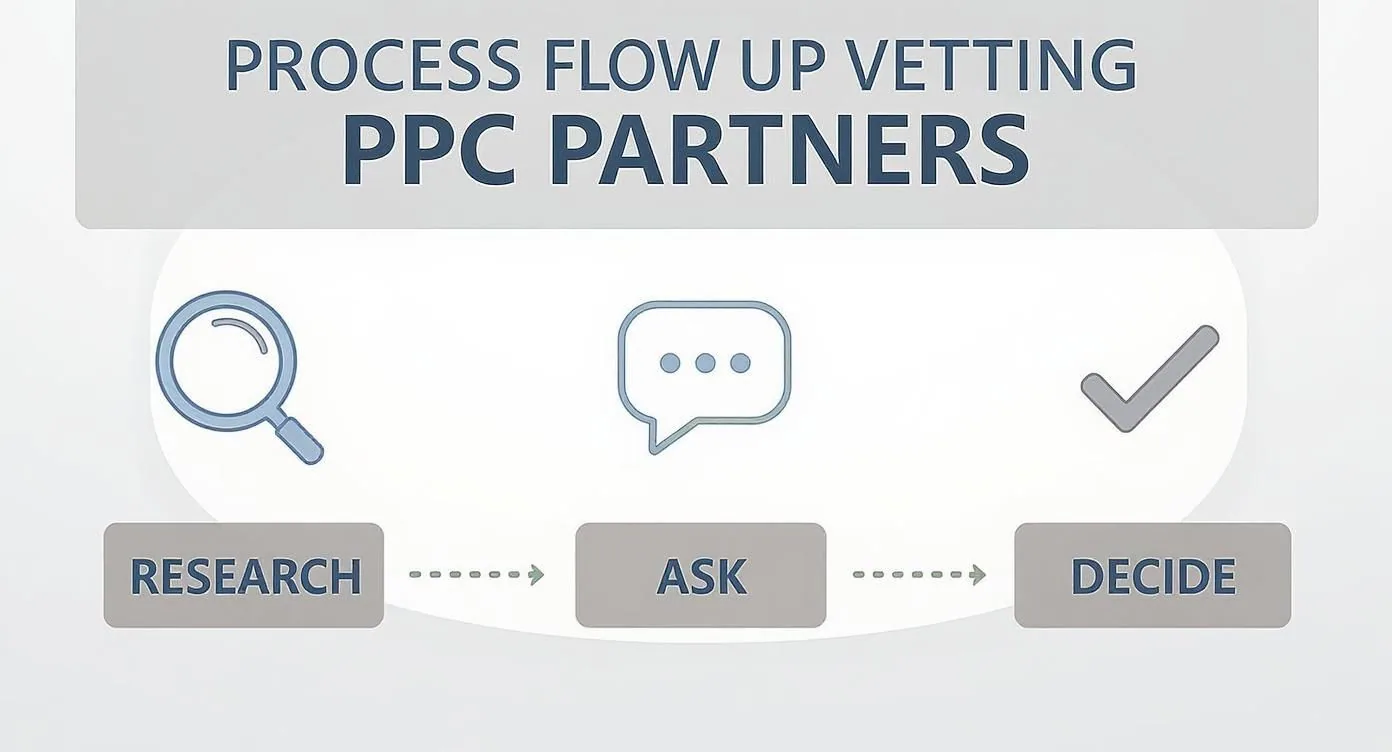
This flowchart shows the simple but critical process for finding and integrating a partner who meets your standards.
This straightforward three-step process—Research, Ask, and Decide—highlights how doing your homework upfront creates the foundation for a successful partnership, which is then locked in by the SLA.
Your SLA needs to clearly define:
Response Times: How fast will your partner get back to you? It’s smart to specify different windows for everyday questions versus urgent campaign fires.
Reporting Frequency: Will you get reports weekly, bi-weekly, or monthly? Nailing this down ensures you always have the data you need for client check-ins.
Data Tracking and Ownership: Get confirmation that all tracking is set up correctly from the get-go. To dig into this technical foundation, it’s worth understanding how Google Tag Manager bridges marketing and IT efforts.
Escalation Procedures: What’s the plan if a campaign starts tanking? A good SLA outlines the exact steps for flagging major issues and developing an action plan.
Common Questions About White Label PPC Services
Deciding to bring on a white-label partner is a big move. It’s totally normal to have a ton of questions. After all, you’re not just outsourcing a few tasks—you're trusting another team with your client's success and your agency's reputation.
Let's walk through the most common concerns we hear from agencies. Getting clear, honest answers to these questions is the first step toward building a partnership that actually works and makes you money.
How Do I Maintain Control Over My Client Campaigns?
This is usually the first question agency owners ask, and for good reason. You’ve worked hard to build that client relationship. The last thing you want is a "black box" where you send instructions and hope for the best.
A good partner ensures you never lose control. You should have a dedicated dashboard giving you a real-time, unfiltered view of every campaign. Your role is to steer the ship—you set the strategy, define the goals, and own the client relationship. Your white-label team is the expert crew in the engine room, making sure you hit your targets. They provide the performance data and insights you need to walk into client meetings with confidence.
Control isn't about micromanaging daily bids. It's about setting the strategic direction, holding your partner accountable to clear KPIs, and owning the client relationship, all backed by completely transparent data.
Who Is Responsible for Communicating with My Client?
Simple: You are. A true white label PPC services model means you handle 100% of the client communication. This is a hard-and-fast rule that keeps your brand front and center and reinforces your value as their main strategic guide.
Your provider’s job is to make you look like a rock star. They should arm you with professionally branded reports, detailed performance notes, and smart recommendations. You then take that intel and deliver it to your client in your own voice, framed within their larger business goals. This setup keeps your brand's integrity intact, always.
What Happens When a Campaign Is Underperforming?
This is a question you absolutely need to ask during the vetting process. If a provider promises you nothing will ever go wrong, run. That’s not how PPC works. A real partner won’t sell you a fantasy; they’ll have a clear, data-driven plan for when things inevitably need a tune-up.
When KPIs aren't being met, a professional white-label team should be the first to flag it and figure out why. They’ll dig into the data to see if it’s ad fatigue, rising CPCs, a tracking glitch, or a new competitor shaking things up.
Once they know the cause, they should come to you with a concrete action plan to turn things around—no excuses, just solutions. Your Service Level Agreement (SLA) should spell out this exact process, so you know there’s a structured, collaborative approach to fixing problems, not just finger-pointing.
Is This Different from Just Hiring a Freelancer?
Yes, and it’s a night-and-day difference. A great freelancer can be a fantastic help, but a white-label partnership is built for a different purpose: scale, reliability, and deep resources. Hiring a freelancer is adding a person; partnering with an agency is adding a system.
Here's a quick breakdown of what that really means:
Team vs. Individual: You get an entire team—analysts, copywriters, strategists—not just one person's brain.
Systems vs. Ad-Hoc Process: A professional firm has proven, repeatable processes for everything from onboarding a new client to reporting and crisis management.
Redundancy and Scalability: What happens if your freelancer gets sick, takes a vacation, or is just swamped? Your client’s campaign stalls. A white-label agency has built-in backup, so the work never stops.
Tools and Technology: You get the benefit of their enterprise-level software stack without having to shell out thousands in subscription fees.
At the end of the day, a white-label partner brings an operational maturity that a solo contractor just can't offer. It translates to more consistent results, smarter strategies drawn from managing hundreds of accounts, and the ability to grow your PPC offerings without hitting a ceiling. It's the model for agencies serious about building a reliable, scalable revenue stream.
Ready to expand your agency's capabilities without the overhead? At UFO Performance Marketing, we provide transparent, expert-led white label PPC services that act as a seamless extension of your team. Discover how we can help you scale profitably.