How a Data Driven Marketing Agency Turns Metrics Into Revenue
AL
Andrea Larsen
So, what exactly is a data-driven marketing agency? Think of them as a partner that puts customer data and analytics at the very center of every single strategic decision. They ditch the guesswork and old-school intuition to build marketing campaigns that deliver measurable, predictable business growth.
Curious to see how data could sharpen your own strategy? Get a free, no-obligation audit of your marketing or PPC strategy today.
What a Data-Driven Marketing Agency Actually Does
Let's use an analogy. A traditional marketing team might operate like a chef who follows a standard recipe, hoping the final dish is a hit. A data-driven agency, on the other hand, is like a master chef who is constantly tasting, tweaking, and adjusting the ingredients based on real-time feedback from the people actually eating the meal.
This approach completely changes the game. It shifts the focus from creative hunches to cold, hard evidence.
With a data-driven partner, every dollar has a job to do. Decisions aren't based on what should work in theory; they’re made based on what the numbers prove is working right now. It’s a constant cycle of testing, learning, and refining to hit very specific business goals.
Moving Beyond Vanity Metrics
One of the biggest changes these agencies bring to the table is steering clients away from vanity metrics. Sure, getting a lot of likes, shares, and impressions feels great, but those numbers often have little to do with actual revenue.
A true data-driven agency gets you focused on the metrics that actually matter to your bottom line. They zoom in on things like:
Customer Acquisition Cost (CAC): How much does it truly cost you to bring in a new paying customer?
Customer Lifetime Value (CLV): What is the total profit you can expect to make from an average customer over their entire relationship with your business?
Return on Ad Spend (ROAS): For every single dollar you put into advertising, how many dollars are you getting back in revenue?
Lead-to-Close Ratio: What percentage of your hard-earned leads actually become paying customers?
This intense focus on business outcomes ensures marketing isn't just a creative department, but a crucial part of your company's financial success.
A data-driven approach transforms marketing from a cost center into a predictable revenue engine. It’s about making smarter, evidence-based decisions that consistently drive growth and prove the value of every campaign.
The Core Philosophy: Data Over Opinion
Deep down, the philosophy is simple: let the data lead. This requires being nimble enough to change course when the analytics point to a better way. If an ad campaign isn't performing, it's not seen as a failure—it's just a new data point that tells you what to test next.
To really get what makes these agencies different, you have to look at their approach to social media analytics and reporting. This isn't just about pulling numbers for a monthly report; it's the real-time compass that guides every single choice. It helps them pinpoint the most profitable audiences, write ad copy that resonates, and decide where to spend the next dollar. This constant feedback loop is what truly separates them from agencies still stuck in the old, less accountable ways of doing things.
The Core Strategies That Drive Measurable Growth
A truly data-driven marketing agency doesn't just collect information for the sake of it. They turn that raw data into decisive action and, ultimately, profitable growth. This is where insights from analytics become the foundation for strategies that directly impact your bottom line. Instead of throwing ideas at a wall to see what sticks, every move is a calculated step toward a measurable goal.
This approach isn't just a trend; it's become essential for survival and growth. In fact, 64% of companies now have a dedicated data-driven marketing strategy, and an identical 64% of marketing executives strongly agree it's critical for success. With the search advertising market alone projected to hit $351.55 billion by 2025, the stakes have never been higher.
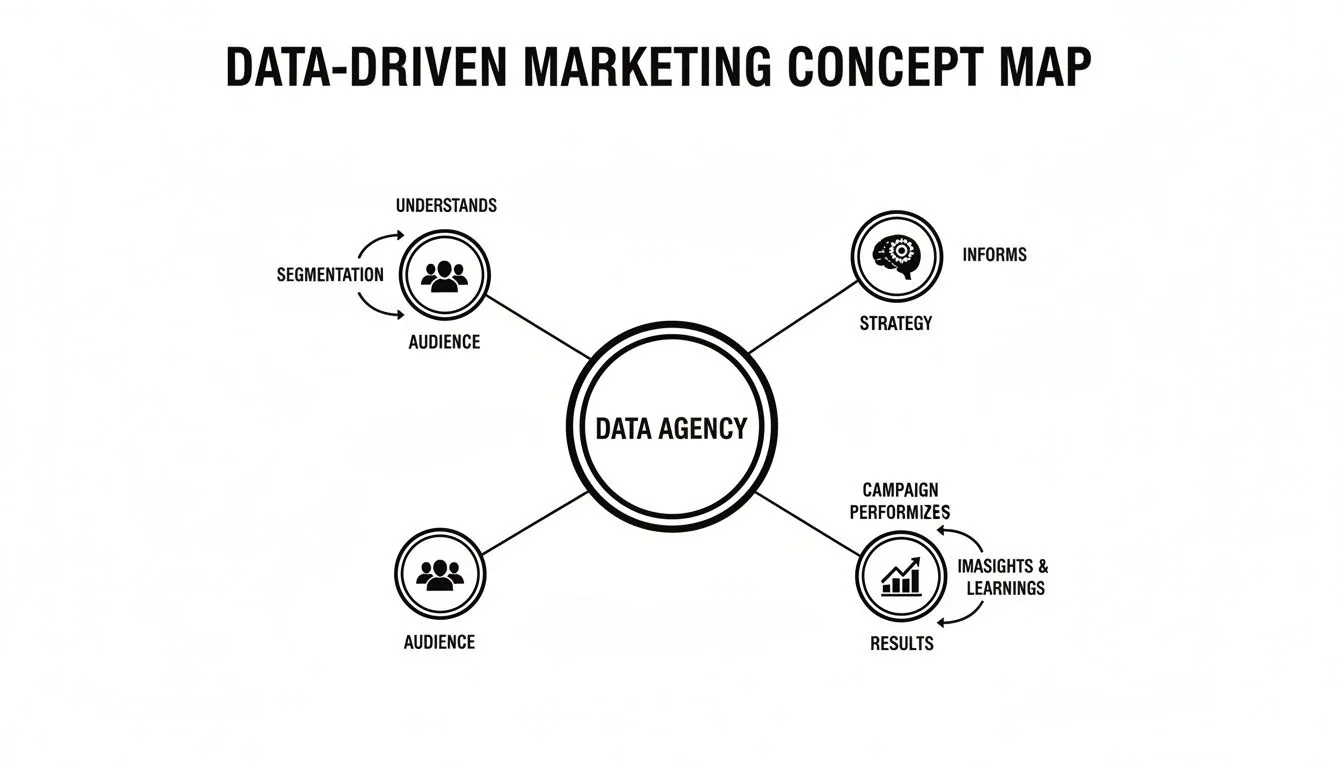
This concept map perfectly illustrates how a data-driven agency connects the dots between audience insights, strategic planning, and tangible results to create a cohesive growth engine.
The key takeaway here is that success isn't about being great in just one area. It’s about creating a continuous feedback loop where audience data informs your strategy, and your execution produces results that, in turn, help you refine your targeting even further.
Let's compare the old way of thinking with this modern, data-first mindset.
Data-Driven vs. Traditional Marketing Approaches
Aspect
Traditional Marketing Approach
Data-Driven Marketing Approach
Strategy
Relies on intuition, past experience, and broad assumptions about the audience. "This feels right."
Based on behavioral data, market analysis, and predictive modeling. "The data shows this will work."
Audience
Targets broad demographics (e.g., women ages 25-40).
Creates highly specific segments based on user behavior, purchase history, and online interactions.
Measurement
Focuses on vanity metrics like impressions, reach, or general brand awareness.
Tracks concrete business outcomes like Cost Per Acquisition (CPA), Customer Lifetime Value (CLV), and ROI.
Optimization
Campaigns are often set and left to run. Changes are infrequent and based on gut feelings.
Involves constant A/B testing, analysis, and refinement to improve performance in real-time.
As you can see, the difference is night and day. A data-driven approach removes the guesswork, allowing for more precise, effective, and accountable marketing. Four core pillars typically support this structure: SEO, PPC, Paid Social, and CRO. While each serves a unique function, they work best when they're interconnected.
Data-Driven SEO
Search Engine Optimization is no longer about just stuffing keywords onto a page and hoping for the best. A data-driven approach turns SEO into a science, focusing on understanding and satisfying what a user really wants when they type a query into Google.
It all starts with a deep dive into the data. Instead of guessing, an agency will analyze:
Search Intent Data: Are users looking for information ("how to fix a leaky faucet"), comparing products ("best tankless water heaters"), or ready to buy ("plumber near me")? The data reveals the true purpose behind every search.
SERP Analysis: What kinds of content are already ranking on page one? This tells you whether you need a blog post, a product page, or a detailed how-to guide to even have a chance at competing.
User Engagement Metrics: Are visitors leaving your page after just a few seconds? A high bounce rate is a clear data signal that your content isn't meeting their expectations, telling you exactly what needs to be fixed.
This process ensures you’re not just creating content to rank, but to genuinely help and convert visitors by perfectly matching their needs.
Performance PPC
Pay-Per-Click advertising is a goldmine of immediate data, and a top-tier agency uses every last bit of it. Performance PPC is all about maximizing your Return on Ad Spend (ROAS) through relentless testing and optimization. The average PPC campaign might deliver a 200% ROI, but a truly data-led approach can push that figure much higher.
An agency will systematically test and refine variables like:
Ad Copy A/B Testing: Which headline gets more clicks? Which call-to-action drives more form fills? The data gives you the definitive answer, not someone's opinion.
Bid Optimization: Instead of paying the same for every click, data on lead quality allows for smarter bidding. You can focus your budget on the keywords that bring in high-value customers and pull back on the ones that don't.
Landing Page Performance: By analyzing heatmaps and session recordings on your landing pages, an agency can spot friction points and optimize the page to get more people to take action.
This creates a powerful feedback loop where every dollar you spend gives you new information to make the next dollar you spend even more profitable.
Strategic Paid Social
Paid social campaigns are your chance to find ideal customers—even the ones who don't know you exist yet. A data-driven agency uses the powerful analytics tools within social platforms to build incredibly specific audience segments that go far beyond basic demographics.
A data-driven social strategy moves beyond broadcasting a message to everyone and instead focuses on starting a conversation with the right people, at the right time, with the right offer.
The process involves using sophisticated targeting tools, such as:
Audience Segmentation: Grouping users based on their past purchase behavior, website interactions, or content engagement to deliver ads that feel hyper-relevant and personal.
Lookalike Audiences: Taking the data from your best existing customers and using it to find new, similar users on platforms like Facebook and LinkedIn. This dramatically expands your reach to prospects who are pre-qualified to be a good fit.
This highly targeted approach ensures your ad spend is focused on the users most likely to become loyal customers, preventing wasted budget on audiences who will never convert.
Conversion Rate Optimization (CRO)
Getting traffic to your website is only half the battle. Conversion Rate Optimization (CRO) is the final, critical piece of the puzzle, where data is used to persuade more of those hard-won visitors to take action. This discipline is all about understanding user behavior on your site to identify and remove any barriers standing in the way of a conversion.
To do this, agencies rely on a variety of data-gathering tools, including:
Heatmaps: These tools create visual maps showing where users click, scroll, and move their mouse, revealing what grabs their attention and what gets completely ignored.
Session Recordings: Watching anonymized recordings of real user sessions on your site shows you exactly where people get stuck, frustrated, or confused.
Funnel Analysis: By tracking users through a multi-step process (like a checkout or lead form), you can pinpoint the exact stage where they drop off, highlighting the biggest opportunity for improvement.
Each of these strategies is a powerful component on its own, but their true impact is realized when they work together. By connecting data from all four pillars, a great agency builds a comprehensive growth engine that is both powerful and predictable.
How AI and Automation Supercharge Marketing Results
The best agencies don't just use technology—they use it as a force multiplier to get a serious edge over the competition. AI and automation aren't just buzzwords anymore; they're the engines that allow a modern data-driven marketing agency to chew through massive datasets, make smarter decisions on the fly, and deliver far better results for clients.
Think of it like this: if data is the fuel, then AI is the high-performance engine that converts it into incredible speed and precision. It spots patterns and opportunities in data at a scale no human team ever could, allowing for a proactive, strategic approach instead of a reactive one.
This is quickly becoming the new normal. Programmatic advertising, which is essentially AI-powered ad buying, is set to eat up 87% of all digital display ad budgets by 2025. It doesn't stop there. Over 70% of marketers already use generative AI to help create content, and 59% of marketing leaders rely on it for personalization. This tech is everywhere.
Programmatic Advertising: The AI Stock Market for Ads
One of the coolest and most powerful uses of AI is in programmatic advertising. Instead of a human manually buying ad space, programmatic platforms act like an automated stock market for ads. In the few milliseconds it takes a webpage to load, AI algorithms analyze the visitor, decide what they're worth to an advertiser, and bid against other AIs to place the perfect ad in front of them.
This all happens in the blink of an eye. The result? Ad budgets are spent with maximum efficiency, targeting only the most relevant people at the best possible price.
Hyper-Personalization at Scale
AI is also the secret sauce behind hyper-personalization—the ability to tailor a message to an individual based on their specific behavior, and do it instantly. Ever look at a pair of shoes online, then see ads for those exact shoes following you around the internet? That's AI-driven personalization doing its thing.
This tech can change a website’s content, tweak an email's special offers, or adjust an app's recommendations based on what you’ve looked at, what you’ve bought, and even where you are. This creates a much more relevant experience for the customer, which naturally leads to way more conversions.
AI and automation don't replace skilled marketers; they amplify their abilities. These tools handle the complex data analysis and repetitive tasks, freeing up human strategists to focus on creative problem-solving, high-level planning, and building client relationships.
Practical Ways AI Shows Up in Marketing
Beyond slick ads and custom homepages, a sharp data-driven marketing agency uses AI and automation for a whole host of tasks that make campaigns work better. For a deeper dive, you can check out different AI automation solutions to see the range of possibilities.
Here are a few key examples:
Predictive Analytics: AI models comb through past data to predict what’s coming next. This could be forecasting sales trends, spotting which customers might be about to leave, or identifying which leads are most likely to turn into sales.
Content Optimization: AI tools can analyze what content is already performing well and give you pointers on better headlines, keywords, and topics. This helps you create stuff people actually want to read and share.
Intelligent Lead Filtering: Automation can be a lifesaver for sifting through new leads. It automatically weeds out spam and junk submissions, saving a ton of time. This ensures the sales team only talks to people who are actually interested, which we demonstrated in a case study about using AI to filter spam leads and reclaim 20 hours a month.
At the end of the day, any agency that's serious about growth has to have AI and automation in its toolkit. It's what provides the speed, precision, and intelligence that define high-performance marketing today.
Navigating Agency Pricing and Engagement Models
Figuring out how you'll pay an agency is just as critical as understanding what they’ll do for you. When you partner with a data-driven marketing agency, you're not just making a financial decision; you're choosing a strategic path that reflects your company's appetite for risk and its ambitions for growth. The right payment structure builds a true partnership, one based on transparency and a shared obsession with hitting your business goals.
Agency engagement models run the gamut, from predictable monthly retainers all the way to ambitious performance-based deals. Each one has its own pros and cons depending on your company’s size, budget, and what you’re trying to achieve. Let's walk through the most common setups so you can find the perfect fit.
Standard Engagement Models
For a lot of businesses, predictability is king. Standard models give you a clear scope of work and a fixed price tag, which makes budgeting and planning a whole lot easier. These are fantastic for getting foundational marketing efforts off the ground or for running campaigns where you have a pretty good idea of what’s going in and what should come out.
There are two main players in this space:
Monthly Retainer: This is the bread and butter of agency pricing. You pay a set fee every month for an agreed-upon list of services. It works perfectly for ongoing efforts like SEO, content creation, and steady PPC management because it gives the agency the runway to build momentum and continually tweak things for better results.
Project-Based Fees: This is a one-and-done deal. You pay a single fee for a project with a clear start and finish, like a website redesign, a deep-dive SEO audit, or setting up a new analytics dashboard from scratch.
While these models give you financial clarity, their one big drawback is that the agency gets paid for their time and effort—not necessarily for the dollars they put back in your pocket. This is where performance models completely change the conversation.
The Rise of Performance-Based Partnerships
A truly confident data-driven marketing agency is willing to bet on its own success. Performance-based models are the ultimate sign that an agency believes it can deliver real, measurable financial wins. This approach aligns their incentives squarely with yours, creating a powerful partnership where everyone wins together.
This pay-for-performance model shifts the relationship from a simple client-vendor transaction to a genuine growth partnership. The agency is no longer just executing tasks; they become an invested stakeholder in your success, driven by the very same metrics that define your business.
These models demand a high level of trust and a commitment to transparent data sharing, but the potential payoff is huge. It's important to know the different ways these can be structured.
Pay-Per-Lead (PPL): In this setup, the agency gets paid for every qualified lead they bring in. This is a game-changer for B2B companies whose main marketing objective is to keep the sales pipeline full.
Revenue Share: Here, the agency earns a percentage of the revenue that comes directly from their marketing campaigns. It's an incredibly popular model for e-commerce brands because it ties the agency’s pay directly to online sales.
Hybrid Models: Sometimes the best solution is a mix of both worlds. A common approach is to have a smaller base retainer combined with a performance bonus for hitting specific KPIs, like a certain ROAS target or a revenue milestone.
Choosing a model that connects compensation to actual outcomes ensures you’re paying for results, not just activity. It forces everyone to focus on the metrics that truly move the needle, which is the cornerstone of any winning growth strategy. For a closer look at connecting marketing activities to financial outcomes, check out our detailed guide on how to calculate marketing ROI.
How to Choose the Right Agency Partner
Picking a data-driven marketing agency is one of the biggest decisions you'll make for your business. It's a real partnership. Get it wrong, and you're stuck with confusing reports and flatlined growth. Get it right, and you’ve found the engine that drives predictable revenue. You have to look past the slick sales pitch to see if they really have the chops.
The right agency won’t just promise you the world; they'll show you the map. That means you need to get your hands dirty—dig into their case studies, ask tough questions about who you'll be working with, and scrutinize their reporting until you're confident they're on the same page as you.
Go Beyond Surface-Level Case Studies
Every agency has a "success stories" page, but let's be honest, most of them are puff pieces. They're often packed with vanity metrics like "we increased traffic by 200%!" or "social engagement went through the roof!" These numbers might sound impressive, but they don't answer the one question that actually matters: did they make their client any money?
A true data-driven partner connects every action back to real business results. When you're looking at their past work, hunt for proof of what counts:
Revenue Growth: Can they show you a clear, measurable lift in sales?
Improved ROAS: How did they make the client's ad budget work harder and become more profitable?
Lower Customer Acquisition Cost (CAC): Did they find a way to bring in valuable new customers for less money?
These are the metrics that keep the lights on. If an agency’s case studies are vague or only talk about top-of-funnel fluff, it's a huge red flag. It probably means they struggle to connect their marketing efforts to your bottom line.
Understand the Team You Will Actually Work With
Here’s a classic agency move: the senior experts charm you during the sales process, but once the contract is signed, your account gets handed off to a junior-level team. Suddenly, the strategic firepower you were promised is gone, replaced by someone learning on your dime.
It is absolutely critical to ask who your day-to-day contact will be and who is ultimately responsible for strategy. Often, a smaller, more focused agency gives you direct access to senior talent. This ensures your account gets the benefit of years of hands-on experience, not just a few months of training.
Don't be shy. Ask direct questions about their team. Who is my point person? How often will I actually speak with the strategist running my campaigns? Their answers will tell you everything you need to know about the level of attention your business will truly get.
Demand Transparent and Actionable Reporting
Reporting is the moment of truth. This is where a data-driven agency either proves its worth or completely fails. A bad partner will just email you a data dump every month—a messy spreadsheet with a hundred different metrics but zero insight. They leave it up to you to figure out what it all means.
A great partner, on the other hand, uses reporting to tell a story. They give you a clean, easy-to-understand dashboard focused on the KPIs you both agreed on. More importantly, every report they deliver should answer three simple questions:
What Happened? Here’s how we performed against our goals, plain and simple.
Why Did It Happen? Here’s our analysis of the data that explains the results.
What Are We Doing Next? Here are the specific actions we’re taking to improve.
That's not just reporting; it's a strategic roadmap. This level of clarity is the hallmark of a genuine growth partner.
Key Questions to Ask Any Potential Agency
To cut through the jargon and find an agency that truly lives and breathes data, you need to ask the right questions. Use this checklist to vet any potential partner:
Strategy & Adaptation: "Walk me through a campaign where you had to completely change direction based on the data. What happened, what did the numbers tell you, and what was the final result?"
Connecting to Sales: "How, specifically, do you trace your marketing activities back to our sales pipeline and revenue?"
Reporting & Communication: "Can I see a real example of a monthly performance report you send to clients? How do you communicate wins, losses, and what you’re doing next?"
Team & Expertise: "Who exactly will be working on my account? What’s their experience in our industry and with goals like ours?"
The demand for these services is exploding. The global digital advertising and marketing market was valued at $667 billion and is on track to hit $786 billion by 2026. With digital channels now gobbling up nearly 73% of worldwide ad spend, it's clear that businesses are betting big on data. You can discover more insights about digital marketing statistics on recurpost.com to see the full picture. Finding the right partner is your ticket to claiming a piece of that growth for yourself.
Frequently Asked Questions
Choosing the right marketing partner can feel like a shot in the dark. How do you find an agency that actually moves the needle on what matters most—your bottom line? Here, we'll answer the questions we hear most often from businesses trying to navigate this process and find a truly data-driven team.
How Long Does It Take to See Results?
This is the big one, and the honest answer is: it depends on the channel. Think of it like investing. Some strategies are designed for quick returns, while others are about building long-term, compounding value.
With things like Performance PPC or paid social ads, you can often see the first positive signals within 30 to 60 days. In that initial window, the agency is getting a feel for the landscape—gathering baseline data, testing different ad creative and audiences, and optimizing for those first few wins. This is where you get immediate feedback on what messages are landing with your customers.
On the other hand, foundational plays like SEO and content marketing are a slow burn. You're building an asset, not just running an ad. It takes time to earn trust from search engines and build authority. You'll typically start seeing meaningful, lasting results from these efforts in about 4 to 6 months. The magic here is in the momentum; every bit of data gathered makes the next move smarter.
What Kind of Data Does My Business Need to Provide?
This is a common worry, but you probably have more than you think. A skilled agency isn't just looking for a perfect dataset—they know how to work with what you have and build from there.
To kick things off, they'll usually ask for access to a few key places:
Google Analytics: This is the treasure map of your website, showing how people find you, what they do when they get there, and where they drop off.
Ad Platform Accounts: Letting them see your history in Google Ads, Meta Ads, or LinkedIn Ads shows what you’ve tried, what worked, and what didn't.
CRM Data: If you use a system like HubSpot or Salesforce, this data is gold. It connects marketing efforts to actual sales, revealing lead quality and customer lifetime value.
A great data-driven marketing agency doesn't just analyze the data you already have; it builds a framework to generate new, actionable insights. The goal is to continuously enrich your understanding of the market and your customers through structured testing and campaign execution.
This initial information is just the starting point. From day one, every campaign becomes a new source of intelligence, turning your marketing into an engine for learning.
Is a Data-Driven Agency Only for Large Companies?
Not at all. In fact, you could argue that a data-driven approach is more critical for small and medium-sized businesses (SMBs).
When you're an SMB, every single dollar in your marketing budget has to pull its weight. There’s no room for guesswork or "spray and pray" campaigns. A data-driven methodology ensures your limited budget is aimed with surgical precision at the tactics most likely to generate a return. It’s about being smarter, not just bigger, and it’s how smaller players can go toe-to-toe with their larger competitors.
What Makes a Data-Driven Agency Different?
At its core, the difference is a shift in mindset: from being activity-focused to being outcome-obsessed.
A more traditional agency might report on vanity metrics—clicks, impressions, follower counts. Those numbers look nice on a slide, but they don't always translate into a healthy business. It feels like motion, but is it progress?
A data-driven marketing agency flips the script. They start with your business goals—revenue, qualified leads, customer acquisition cost—and reverse-engineer a strategy to hit them. Every keyword they target, every audience they build, every ad they write is a calculated move designed to impact those bottom-line numbers. Strategy isn't just based on a cool creative idea; it’s validated, tested, and refined by what the performance data says is actually working. That relentless focus on measurable results is what truly makes them different.