

Want to sound smart? Don't use the terms SEO or SEM. Actually, you do you, but if you want our recommendation: use the terms organic search and paid search instead and you'll sound like you really know your stuff.
Definitions
SEO stands for Search Engine Optimization and includes any work designed to get you ranked in the organic section of the search results. SEM stands for Search Engine Marketing and typically refers to paid search advertising. But they're both marketing, so the distinction doesn't really make sense.
Here's a pretty graphic we made to illustrate the difference (click to enlarge). Then read down below for more detail.
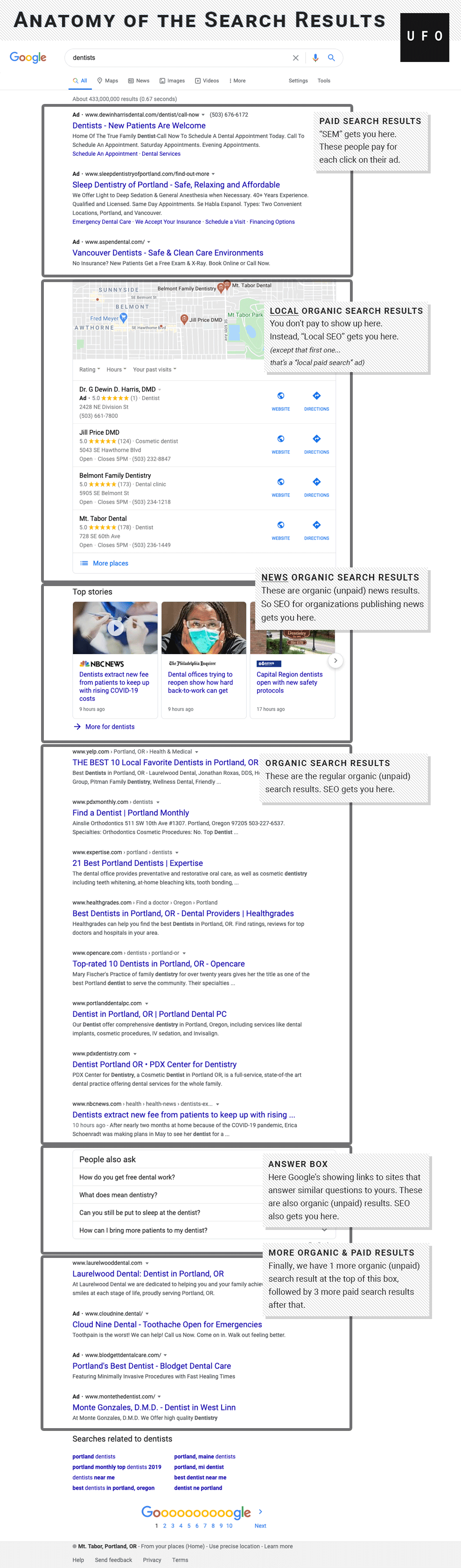
Paid vs. Organic Search
Better terms to use are paid search to refer to the paid search results, and organic search to refer to the organic search results. As you can see in the image above, it gets a little more complex than just that, but using paid and organic to differentiate the two is the more accurate way to do it.
Paid Search (SEM)
Paid search results are the search results marked by an "Ad" icon. Those are advertisements and those organizations are paying Google for every click on their ad. This is also called PPC or Pay Per Click advertising (although that's sort of a misnomer too).
With paid search, you pay Google through the Google Ads platform, and If you stop paying, you stop showing up.
Organic Search (SEO)
Organic search results are most of the search results you see when you search Google or Bing. These organizations do not pay for each click on those results. Instead they do SEO, which gets them higher in those search results. So SEO's not free, you still pay an organization like us to help get you improve your rankings, but you don't pay for each click on your ad like you do with paid search.
It can take a lot of work to get ranked in the first place, but once ranked, the ROI of organic search is usually higher than paid search because, in most cases, the work required to stay ranked is far less than the costs of paying to show up in paid search for the same keywords.